A program manager leads a group of related projects toward a business outcome, while a project manager delivers one project with a defined scope, schedule and budget. The project manager asks whether the work will ship on time. The program manager asks whether shipping it changes anything for the business.
- If your work ends when a deliverable's handed over, you're doing project management. If it ends when a business result shows up, such as faster onboarding or lower churn, you're doing program management.
- When both roles exist, project managers usually report to the program manager, who's accountable for the combined result.
- US pay is close: Indeed puts the average base salary at $99,197 for program managers and $100,408 for project managers.
- The PMP is the project credential and the PgMP the program one. Both exams run 240 minutes, but the PgMP adds a panel review of your experience.
- You'll need a program manager when several projects compete for the same people or budget, or when projects finish on time but the business result keeps slipping.
The rest of this page backs that rule with an example, US pay from three sources and the exact PMI requirements for each certification.
What Is the Difference Between a Program Manager and a Project Manager?
A project manager is the person accountable for one project: its plan, its team, its budget and its delivery date. A program manager's accountable for a program, meaning a set of related projects whose combined result matters more than any single deliverable. When both roles exist, project managers usually report to the program manager. The Project Management Institute (PMI) draws the same line in its standards and certifications, with the PMP for project managers and the PgMP for program managers.
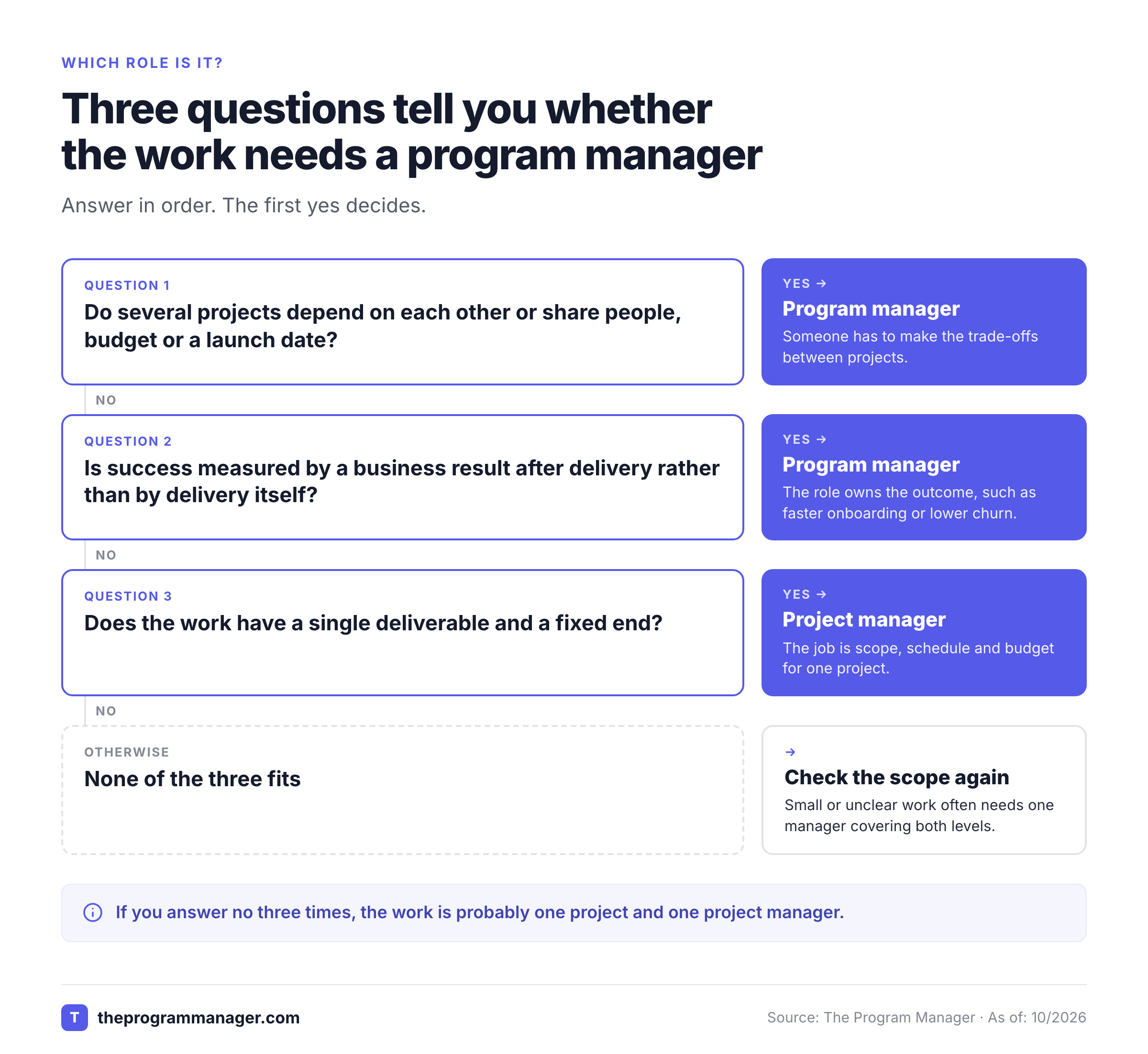
Three questions separate the roles quickly:
- Does the work have a single deliverable and a fixed end? That's work for a project manager.
- Do several projects depend on each other and share people, budget or a launch date? That's work for a program manager.
- Is success measured by the delivery or by the business result afterward? Delivery is project management, the result is program management.
Program Manager vs Project Manager at a Glance
The two tables below compare the roles on nine criteria. Titles vary by employer, so it's the typical split, not a rule every company follows.
| Role | Scope | Goal | Time horizon | Success measure | Main output |
|---|---|---|---|---|---|
| Project manager | One project with a defined deliverable | Deliver on time, on budget and to scope | Ends when the project closes | Schedule, budget, scope, quality | The project deliverable |
| Program manager | Several related projects and the work between them | Realize the business benefit the projects were funded for | Runs until the benefit is reached, often longer than any one project | Benefits delivered, milestones across projects, risk exposure | A coordinated roadmap, a shared risk picture and a benefits case |
The comparison's second half covers people, decisions and credentials.
| Role | Who they manage | Typical decisions | Reports to | Typical credential |
|---|---|---|---|---|
| Project manager | A project team | Task order, scope trade-offs inside the project | Program manager, PMO or department head | PMP |
| Program manager | Project managers and cross-functional leads | Which project gets people, money or priority when they compete | Director, VP or executive sponsor | PgMP, often after the PMP |
How Does a Program Differ From a Project?
The two roles differ because what they're managing differs. A project is chartered to create a defined deliverable as efficiently as possible, and a program coordinates several related projects and other activities over time to deliver benefits to the organization. That's the framing in a PMI Global Congress paper by Patrick Weaver, and that's how most employers use the words.
Scope and boundaries
A project has edges. You can write down what's in, what's out and what done looks like. A program has a goal instead, such as moving every customer to a new billing system, and the projects inside it are the means. A program's scope questions are rarely "is this task in scope" and more often "which project should carry this work."
Timeline
Projects end. Programs run until the benefit arrives, and they often adapt as conditions change. That's why a program manager stays with an initiative through several project cycles, while a project manager tends to move on to the next project once the handover is done.
How success is measured
Success is measured differently at each level: a project succeeds when it delivers the agreed scope on time and on budget. A program succeeds when the benefit shows up, even if one of its projects shipped late or got dropped. It can also finish with every project delivered and still fail, because the business result never arrived.
Program Manager vs Project Manager: A Worked Example
Say a software company wants to cut the time new customers need to get started from 30 days to 10. That ambition is the program. It needs three projects, and each one's got its own project manager.
| Project | Project manager's job | Program manager's concern |
|---|---|---|
| Rebuild the signup flow | Ship the new flow by the agreed date within the design team's capacity | Whether it launches before the data migration, because the new flow expects clean accounts |
| Migrate customer data | Plan the cutover, test the mapping and keep the migration inside budget | Whether the migration team is also needed on the signup project in the same month |
| Train the success team | Build the training plan and run the sessions | Whether training happens before launch, not after the first tickets arrive |
The three project managers each report their own status. The program manager reads them together and spots what none of them can see alone: two projects want the same engineers in March, and the training date sits after the launch date. The decision isn't "which task goes first" but "which project waits," and that sits above any single project manager's authority.
What Does Each Role Do Day to Day?
Project managers and program managers both plan, communicate and manage risk, so the work is easy to blur. What changes is the unit they're planning and communicating about.
The project manager
A project manager's week stays inside one project:
- writing and updating the schedule and the budget
- running the stand-ups and keeping the team unblocked
- tracking risks, issues and scope changes
- reporting status to the sponsor and to the program manager
The program manager
A program manager's week goes to the links between projects:
- maintaining a roadmap that shows how projects depend on each other
- negotiating shared people and budget between projects
- running governance, which means decision meetings, approvals and escalations
- tracking whether the program's expected benefits are still on course
- reporting to executives in business terms rather than task terms
Where the work overlaps
The work overlaps most in a small company, where one person often does both. A single manager with three small projects plays project manager in the morning and program manager in the afternoon. The titles split only when there are so many dependent projects that nobody can hold the whole picture and still run the details of each one.
Skills and Tools Each Role Needs
The skills overlap more than the titles suggest. Both roles need planning, clear writing, stakeholder management and the ability to lead people who don't report to them. The emphasis moves as you go up.
- Project managers lean on scheduling, estimation, scope control and day-to-day team leadership.
- Program managers lean on dependency mapping, prioritization across competing projects, financial judgment and communication with executives.
Tools follow the same pattern. Project managers work in project management software such as task boards, Gantt charts and timesheets. Program managers need views that roll up across projects: dependencies, milestone risk and shared capacity. If you're choosing tools for that second job, our comparison of the best program management software compares 10 options with prices checked on vendor pages, including  Asana,
  Jira and
  Microsoft Planner and Project.
The Program Manager, the product behind this blog, is aimed at the program side. It maps dependencies across Jira and Asana projects and watches milestones for risk. Signup is invite-only right now, and it's built to sit next to your trackers, not replace them.
Program Manager vs Project Manager Salary
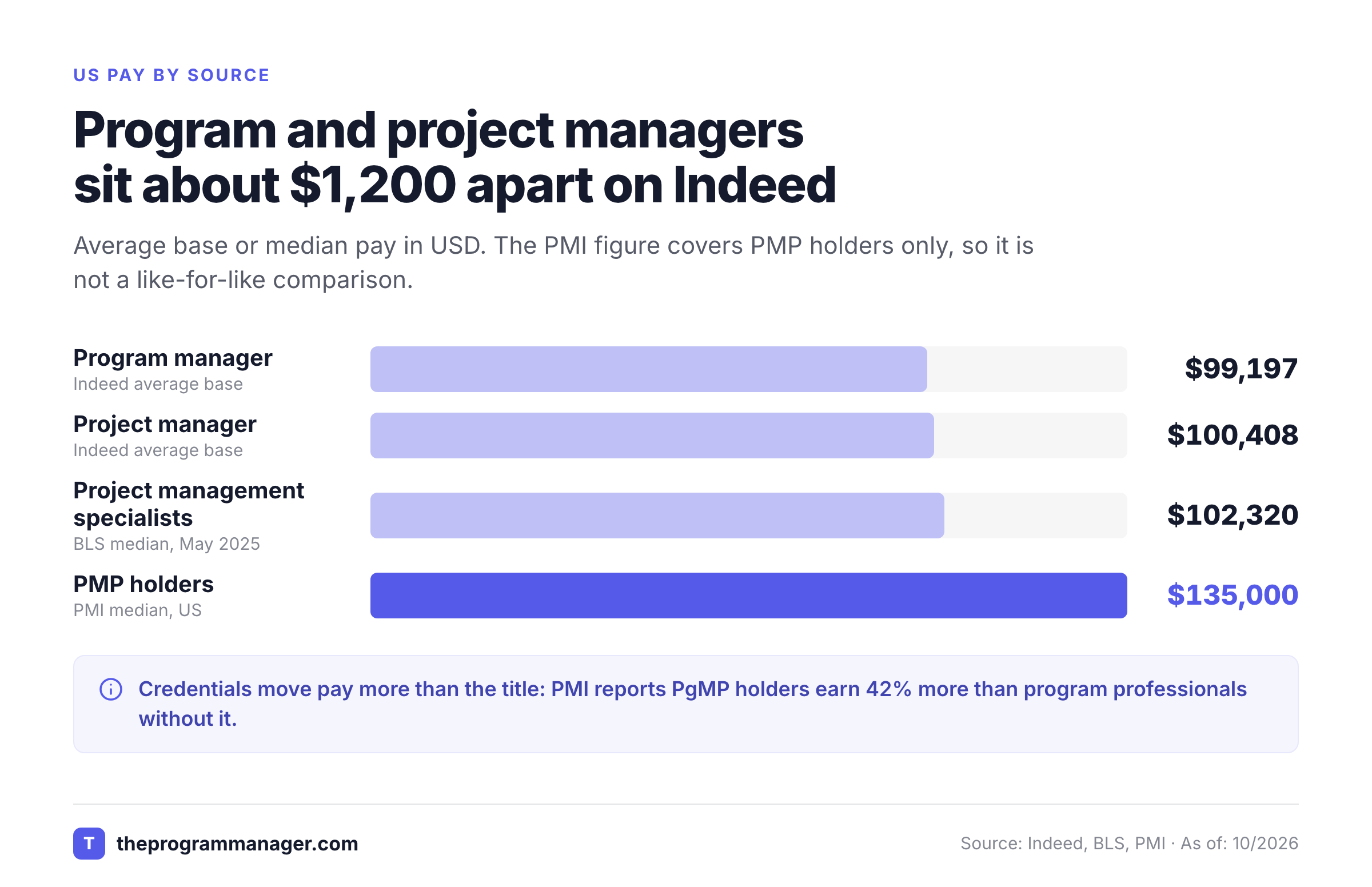
Program managers don't automatically earn more than project managers in the United States. As of October 2026, Indeed puts the average base salary for a program manager at $99,197 (21.4 thousand salaries) and for a project manager at $100,408 (48.6 thousand salaries). Both of Indeed's averages come from job postings over the past 36 months and were last updated on October 5, 2026.
- Indeed's average base for program managers
- $99,197
- Indeed's average base for project managers
- $100,408
- BLS median, project management specialists
- $102,320
- PMI's median for US PMP holders
- $135,000
| Source | Figure (USD) | Basis |
|---|---|---|
| Indeed, program manager | $99,197 average base | Job postings in the past 36 months, updated Oct 5, 2026 |
| Indeed, project manager | $100,408 average base | Job postings in the past 36 months, updated Oct 5, 2026 |
| US Bureau of Labor Statistics | $102,320 median | Project management specialists, May 2025 |
| PMI | $135,000 median | US holders of the PMP certification |
The Bureau of Labor Statistics adds a median of $102,320 for project management specialists as of May 2025, with about 1.09 million jobs and 7% projected growth from 2025 to 2035. BLS doesn't publish a separate figure for program managers.
Level, employer and industry move pay more than the word "program" does. A senior project manager at a large firm can out-earn a program manager at a small one. Credentials are where program managers pull ahead: PMI states that program managers with the PgMP earn 42% more than program professionals without it, and that US PMP holders report a median salary of $135,000. Those are PMI's own figures for its certification holders, so read them as a signal rather than a promise.
PMP vs PgMP: Which Certification Fits Each Role?
The PMP (Project Management Professional) is the credential for project managers, and the PgMP (Program Management Professional) is its program-level counterpart. PMI issues both, and both exams run 240 minutes, but the experience bar differs.
| Requirement | PMP | PgMP |
|---|---|---|
| Aimed at | Project managers | Program managers |
| Education and experience | High school diploma plus 5 years, associate degree plus 4 years, or bachelor's degree plus 3 years managing projects | Three sets: high school plus 4 years of project and 7 years of program experience, bachelor's plus 4 and 4, or a bachelor's from a GAC accredited program plus 3 and 3 |
| Experience window | Within the last 10 years | Within the last 15 years |
| Training | 35 hours of project professional training | Not listed on the PgMP page |
| Exam | 180 questions, 240 minutes | 170 questions, 240 minutes |
| Extra step | None listed | Panel review of your experience before you can schedule the exam |
PgMP holders must earn 60 professional development units (PDUs) in each 3-year cycle to keep the certification. PMI also lets PgMP applicants count a PMP in place of the project-management experience. For most project managers the practical path is the PMP first, then several years of running related projects, then the PgMP. Not every program manager holds one, and plenty of employers hire on delivery record alone.
Is a Program Manager the Same as a Program Director, PMO or Product Manager?
A program manager isn't the same as a program director, a PMO or a product manager. These titles sit close together and get mixed up in job postings, so here's a short definition of each.
Program director
A program director's usually a more senior role than a program manager. At many employers a director oversees several programs or a whole program area, and the program managers report to them. Some companies use "director" and "manager" interchangeably, so check the job description, not the title.
PMO
A PMO, short for project management office, is a team or function that sets standards, provides tooling and supports delivery across projects. A PMO isn't a role you hold but a unit that supports people in those roles. A program manager can run a program with PMO support, and a PMO can serve one program or the whole organization.
Product manager
A product manager decides what a product should do and why, based on customers and the business. A project manager decides how and when a defined piece of work gets delivered. A program manager coordinates several of those pieces. In a software company the three often work on the same launch, each asking a different question.
Which Role Does Your Team Need, and Which Fits You?
Which role fits depends on how many connected projects you've got and who has to make trade-offs between them.
| Your situation | What you likely need |
|---|---|
| One project, one team, one deadline | A project manager |
| Two or three projects with a shared deadline, run by one team | One manager who covers both levels |
| Several projects that compete for the same people or budget | A program manager above the project managers |
| Projects that finish on time but the business result keeps slipping | A program manager who owns the outcome |
| Many programs that need standards and reporting | A PMO, with program managers inside it |
- Project managers keep escalating the same cross-team conflicts to executives
- Each project reports green while the combined launch date keeps moving
- Nobody's accountable for the business result after the last project closes
- The same few people are booked on three projects at once, and nobody's deciding who comes first
For your own career, the question's which work you like. If you enjoy planning, hands-on delivery and seeing a defined thing ship, project management suits you. If you'd rather weigh trade-offs between projects, work with executives and own an outcome over a long period, program management's the better match.
How to Move From Project Manager to Program Manager
Project managers are the most common feeder for program roles, and the move rarely needs a new degree. What it needs is evidence that you can manage the space between projects.
Take on dependent work
Ask to lead or coordinate two related projects instead of one, and write down the trade-offs you made between them.
Own a business metric
Pick a result the projects exist to move, such as onboarding time or ticket volume, and report on it rather than only on tasks.
Learn governance
Run a steering meeting, document decisions and practice escalating with a recommendation attached.
Build the credential gradually
The PMP covers the project side, and the PgMP becomes available once you've got the program experience PMI requires.
Read titles carefully when you apply
Some "program manager" postings describe a senior project manager, and some "project manager" roles already run a program, so don't trust the label alone. Look for words like "multiple projects," "roadmap" and "executive stakeholders."
Program Manager vs Project Manager FAQ
Is a program manager higher than a project manager?
In most organizations, yes: the program manager oversees several projects and often manages project managers, so the role's usually more senior. Titles vary by employer, though, and a senior project manager can hold more responsibility than a program manager at a smaller company.
Do program managers earn more than project managers?
Not by default in the US. The two Indeed averages sit about $1,200 apart, with project managers slightly ahead, so the title alone tells you little. Seniority, industry and credentials such as the PgMP explain most of the gap between individual salaries.
What is 90% of a project manager's job?
The usual answer is communication. The 90% figure's widely attributed to the PMBOK Guide, but it appears to trace back to practitioner claims from the early 2000s rather than a controlled study. A safer reading is that most of the job is talking, writing and aligning people, not building schedules.
Is a program manager the same as a program director?
No. A director usually sits one level higher and answers for several programs, while the program manager runs one. A few employers swap the two titles, so read the job description before comparing offers.
What is the difference between a PM and a PMO?
A PM is a person who manages a project (or sometimes a product or program, depending on the company). A PMO is the office behind them: standards, templates, tooling and reporting for many projects at once.
Is a project manager the same as a manager?
No. A project manager's accountable for a project's delivery and often leads people who report elsewhere, while a people manager has direct reports and handles hiring, reviews and career growth. One person can do both, but the jobs differ.
Leave a Reply