A project charter is a short document that formally authorizes a project and gives the project manager authority to use the organization's resources. This page gives you a charter template you can copy straight into Word, Excel or Google Docs, explains what to write in every field, shows a filled-in example, and covers what changes when you write a charter for a program instead of a single project.
- A project charter authorizes the project and the project manager. Wikipedia, summarizing the PMBOK Guide, says that once it's signed, the project manager can run the project and use organizational funds and resources.
- Keep it short. It states why the project exists, what's in and out of scope, who's involved, the main milestones and the risks, and it points to the detailed plan for everything else.
- Tempo lists eight elements: objectives, scope and deliverables, key stakeholders, high-level budget and resources, high-level risks and constraints, milestones and timeline, success criteria, and roles and responsibilities.
- The sponsor approves it. The University of Waterloo's charter template says the author is typically the project or program manager and the approver is the sponsor.
What Is a Project Charter?
A project charter is the document that formally authorizes a project and gives the project manager authority to apply organizational resources to its work. That's how the PMBOK Guide's definition is summarized by Wikipedia and by PMI-based training material. It's issued by the sponsor or another senior person who can commit people and money, even when the project manager does the drafting.
The charter is the first of the ten documents a program needs. The rest, from roadmap to closure checklist, are collected in our program management templates. Once the charter is signed, the project roadmap template turns it into phases and milestones.
The charter usually sits between two other documents. Before it comes the business case, which argues that the project is worth doing. After it comes the project plan, which describes how the work will be carried out. The University of Waterloo's program charter template puts the boundary clearly: the charter isn't meant to approve the program, which happens earlier at intake, and it isn't meant to document how things will be done, which belongs to planning. In the template's words, it's simply documentation around the authorization given to the manager.
Wikipedia notes that the charter is created in the initiating process group and that it usually refers to more detailed documents rather than repeating them. Summaries of the PMBOK Guide add that the guide doesn't prescribe a format. That's why a charter can be a one-page form, a multi-page document or, in small organizations, a signed memo. What matters is that the same things are written down and the right person has signed.
If you're new to the wider discipline this belongs to, our guide to program management shows where the charter fits when several projects run together.
Project Charter Template You Can Copy
Copy the template below into Word, Excel or Google Docs, or download it as a Word, Excel or PDF file. Under each field, a short note explains what it should contain, and the filled-in text is an illustrative example that you'll replace with your own project. We built the field list from the elements Tempo, Morningmate and Wikipedia describe, and the wording of the guidance and examples is ours.
Project charter template
The filled-in values are an illustrative example (a help center relaunch made up by us) and the small notes say what to write. You'll replace both before it's sent for signature.
- Project name
- Customer help center relaunchA short name people will use in meetings
- Project manager
- Support operations lead (named person)The person accountable for delivery: a named person, not a team
- Sponsor
- Head of Customer SupportThe person who approves the charter and owns the budget decision
- Version and date
- Version 1, draft for sponsor reviewRaise the version whenever it's re-signed
- Links
- Business case, support ticket reportBusiness case, intake request, project plan once it exists
- Purpose
- Customers can't find answers in the help center and open tickets instead, so support answers the same questions every week. The project replaces the structure and the most-used articles.Why the project exists, in two or three sentences
- Objective 1
- Reduce repeat tickets on the ten most common topics by the end of the second quarter, against a baseline measured in the first two weeksSMART: a measure and a date
- Objective 2
- Rewrite the articles behind those ten topics to a single format by the end of week eightSMART: a measure and a date
- Objective 3
- Hand the help center over to the support team with an owner for every article by the end of week tenTwo to four objectives in total
- In scope
- New navigation, search settings, rewritten articles for the ten topics, content guidelinesWhat the project will deliver
- Out of scope
- Translation into other languages, a new ticketing system, product documentation for developersWhat it won't deliver, so nobody assumes it
- Deliverables
- Published help center, content guidelines, handover to the support teamConcrete outputs, each one checkable
| Milestone | Target | How the sponsor checks it |
|---|---|---|
| Baseline measured | End of week two | Repeat-ticket count per topic shared with the sponsor |
| Structure approved | Before rewriting starts | Sponsor's signed off the new navigation |
| Articles for the ten topics rewritten | End of week eight | Articles published in the single format |
| Search live | Before handover | Search settings switched on in production |
| Handover accepted | End of week ten | Every article has a named owner in support |
| Who | Role in the project | What they need from it |
|---|---|---|
| Sponsor (head of customer support) | Approves the charter, decides on scope or date changes | Fewer repeat tickets |
| Support leads | Review answers for accuracy | Articles they can send to customers |
| Legal | Approves articles on refunds or data handling | Correct policy wording |
| Marketing | Approves tone and branding | Consistent brand voice |
| Project team (writers, designer, developer) | Do the work; the project manager leads | Clear scope and quick reviews |
- Budget
- Budget cap set by the sponsorA range or a cap, not a cost plan
- People and tools
- Two writers for six weeks, one designer, one developer for searchWho's needed, and for how long
| Risk | Owner | First response |
|---|---|---|
| Subject experts are slow to review | Project manager | Book review slots with support leads at kickoff, so they're not squeezed later |
| Search settings don't improve results | Developer | Test search on the ten topics before it's launched |
| Support leads are busy during a product launch | Sponsor | Agree review dates around the launch calendar |
- Assumptions
- Support leads can review within three working daysWhat you're counting on
- Constraints
- Launch before the autumn campaignWhat limits you: dates, budget, people you can't get
- Success criteria
- Fewer repeat tickets on the ten topics against the baseline, and a rating on the rewritten articles above a target the sponsor sets at the startHow you'll know it worked after delivery
| Role | Name | Signature | Date |
|---|---|---|---|
| Sponsor | Head of Customer Support | ||
| Project manager | Support operations lead |
Two details make this template more useful than a form people fill in once and forget, though neither is complicated. The first is the "Out of scope" field, which Tempo's one-page and detailed templates also include and that's the cheapest protection against scope creep. The second is the owner next to each risk, because a risk without an owner is a sentence rather than a plan. For the full risk list that grows from here, see our risk register guide.
Project Charter Template in Word, Excel and PDF
A free project charter template works in any format, because the charter is a set of fields and signatures rather than a file type. Summaries of the PMBOK Guide say it doesn't prescribe a format, so a Word document, an Excel sheet, a Google Doc and a PDF form are equally valid, and a template labeled "PMI" is a house style rather than a requirement. Choose the format your sponsor will actually open and sign. The template above comes in all three, with the same fields in each file.
- Word or Google Docs. Best for a charter with paragraphs of explanation. Download the Word file or paste the template, replace the example values and delete the notes.
- Excel or Google Sheets. Best for a simple one-page charter, where each field is a row and the milestones sit in a small table underneath. The Excel download keeps every section on one sheet.
- PDF. Best for the signed copy. Export the finished charter after the sponsor approves it and store that version, so nobody edits it afterwards.
What to Include in a Project Charter
Tempo names eight charter elements and Morningmate names seven, and they overlap almost entirely. Wikipedia's list of typical contents adds the project manager's authority and responsibilities. The table combines them and adds the test we'd apply to each one before sign-off.
| Element | What it answers | A test before you sign |
|---|---|---|
| Objectives | What is this project meant to change? | Each objective has a measure and a date |
| Scope and deliverables | What's in, what's out? | Someone outside the team can tell whether a new request is in scope |
| Key stakeholders | Who's affected or must approve? | Every name has a role and a reason to be on the list |
| High-level budget and resources | How much money and which people? | It's a range or cap, not a detailed cost plan |
| High-level risks and constraints | What could stop it and what limits it? | Top risks have an owner and the constraints are written down |
| Milestones and timeline | When will the sponsor see progress? | Milestones are events you can verify, not activities |
| Success criteria | How will anyone know it worked? | The measure can be read after delivery, not only at launch |
| Roles and responsibilities | Who decides and who does the work? | The sponsor, the manager and the approver are named |
Morningmate makes one distinction worth borrowing for the objectives row. It treats goals as broad statements and objectives as SMART targets, and gives examples such as reducing a website's bounce rate by 15 percent in three months. Those figures are its illustration of a well-formed objective rather than a benchmark, and your own numbers should come from your baseline. If you don't know your baseline yet, write "establish baseline by week two" as the first milestone instead of guessing.
The word "high-level" appears in two of the eight elements for a reason. A charter that tries to settle the detailed budget or the full risk list becomes a plan instead, takes weeks to approve and goes out of date quickly. Keep the detail for the plan, but link to it.
A Filled-In Project Charter Example
The example below is illustrative and made up by us, so it has no real figures. A software company decides to rebuild its customer help center. The charter below fits on one page and is the kind of document a sponsor can read in five minutes.
Project: Customer help center relaunch. Project manager: a named support operations lead. Sponsor: the head of customer support.
Purpose. Customers search the current help center, don't find an answer and open a ticket. Support's answering the same questions every week. The project replaces the structure and the most-used articles so common questions are answered without a ticket.
Objectives.
- Reduce repeat tickets on the ten most common topics by the end of the second quarter. The baseline is measured in the first two weeks.
- Rewrite the articles behind those ten topics to a single format by the end of week eight.
- Hand the help center over to the support team with an owner for every article by the end of week ten.
In scope. New navigation, search settings, rewriting the articles behind the ten topics, content guidelines. Out of scope. Translation, a new ticketing system, product documentation for developers.
Milestones. Baseline measured; structure approved by the sponsor; first batch of articles live; search live; handover accepted.
Stakeholders. Support leads review answers for accuracy. Legal approves articles that describe refunds or data handling. Marketing approves tone and branding. The sponsor decides on any change to scope or dates.
Risks and owners. Subject experts are slow to review (project manager). Search settings don't improve results (developer). Support leads are busy during a product launch (sponsor).
Success criteria. Fewer repeat tickets on the ten topics against the baseline, and a rating on the rewritten articles that the sponsor sets at the start.
Approval. The sponsor and the project manager sign and date the document.
Notice what the example leaves out. There's no task list, no detailed budget and no weekly schedule. Those belong in the project plan, which the charter points to. The charter doesn't need more than the sponsor requires to say yes, yet it must tell the team what they've said yes to.
How to Write a Project Charter in Five Steps
Morningmate describes a five-step process and the University of Waterloo's template gives a similar order of work: read what already exists, draft with the sponsor, review, get approval and store the signed copy. The version below combines the two.
Collect what already exists
Read the business case, the request or intake form and any strategy documents. The charter should repeat the purpose briefly and link to these documents, not copy them.
Draft the purpose, objectives and scope
Write the purpose in two or three sentences, then two to four SMART objectives. List what's in scope and what's explicitly out. Do this before anything else, because every later field depends on it.
Name the people
List the stakeholders, the team and the decision rights. Ask the sponsor who can change scope, budget or dates. If two people think they decide, resolve it now.
Add the high-level numbers and the risks
Write a budget range or cap, four to six milestones, the success criteria and the top risks with owners. Resist adding detail you can't yet defend.
Review, sign and store
Send the draft to the sponsor and the main stakeholders for corrections, fix what they find, then collect the signatures. Store the signed copy where the team can find it, and refer back to it when scope questions come up.
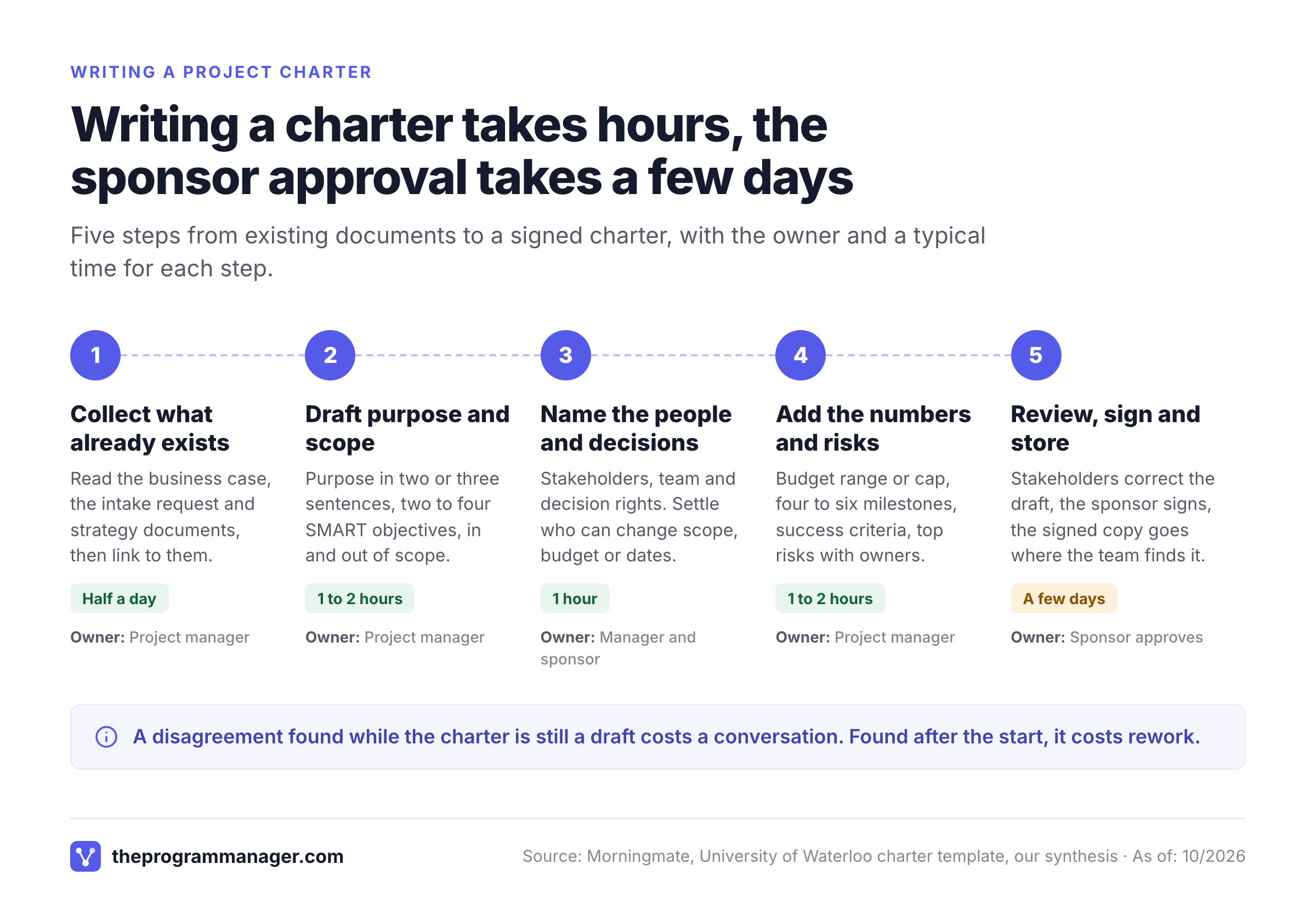
The writing takes a few hours, but the approval takes longer. Delays rarely come from the writing but from the sponsor and stakeholders disagreeing about scope or success criteria, and that's the point of the exercise. A disagreement found while the charter is still a draft costs a conversation. Found after the project has started, it costs rework.
Who Signs a Project Charter and How Long Should It Be?
The sponsor signs a project charter, and the project manager signs to confirm they'll run the project within it. The University of Waterloo's template names the sponsor as the approver and says that when someone else writes the charter, the manager still signs. Wikipedia describes the signed charter as the agreement among the sponsor, key stakeholders and project team on roles and responsibilities.
Length follows the project. Tempo's one-page format fits a small project on a single page, while its detailed format adds resources, costs, stakeholders and risks. Our rule of thumb is to stop adding detail once the sponsor can say yes and the team can say what they've agreed to. If a section needs more than a few lines, it belongs in the plan, and the charter should link to it.
Project Charter vs Project Plan vs Business Case
The three documents answer different questions. Morningmate separates them by purpose and timing, and the University of Waterloo's template draws the same line between authorization and planning. The statement of work, which sometimes gets mixed in, is a separate document that covers work contracted from a supplier. Morningmate's FAQ also addresses how it differs from a charter.
| Document | The question it answers | When it's written | Who it's for |
|---|---|---|---|
| Business case | Why should we do this at all? | Before the charter, and it leads to a decision on whether to proceed | The people who fund the idea |
| Project charter | What exactly are we authorizing, and who's accountable? | After the business case is approved and before detailed planning | The sponsor, the manager and the stakeholders |
| Project plan | How will the work be carried out, monitored and closed? | After the charter is approved | The project team |
| Statement of work | What will a supplier deliver for us? | When work is contracted out | The client and the supplier |
Here's the same order as a sequence, including the loop back to the charter when scope changes.
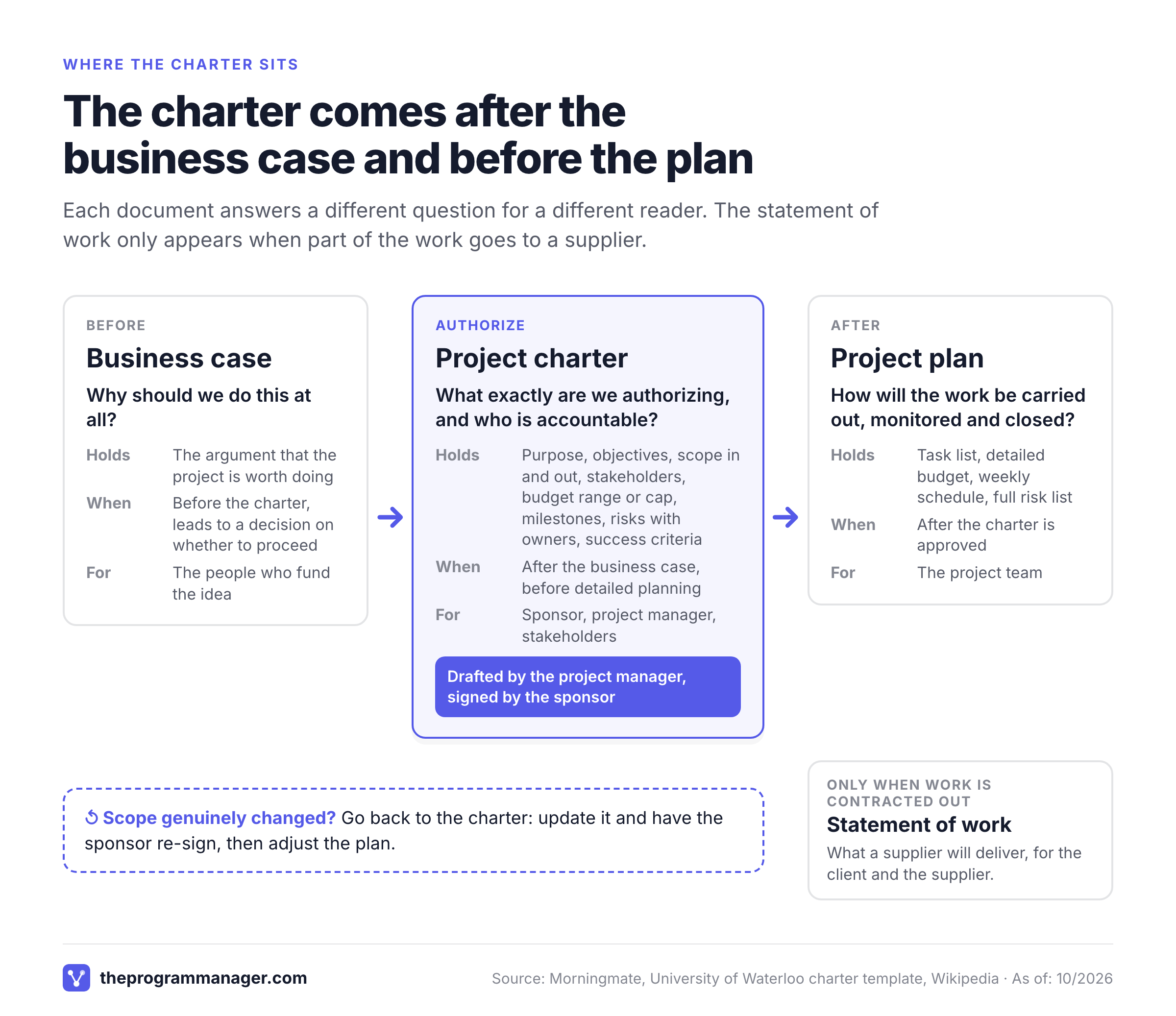
In practice the boundaries blur on small projects, however. A two-person project may have a business case that's one paragraph and a charter that's one page. That's fine, although you should still be able to say which paragraph justifies the work and which one authorizes the manager.
One-Page, Detailed or Agile: Which Charter Format?
Tempo offers three formats, and they differ in how much they carry. A one-page charter covers the project name, manager, sponsor and cost and completion estimates, plus an overview with purpose, deliverables and success criteria, a scope with out-of-scope items, and a schedule of milestones. The detailed version adds resources, costs, stakeholders with expected benefits, and risks and constraints. The agile version is lighter: general details such as the champion and the stakeholders, a project summary, objectives and success criteria.
Side by side, here's how the three formats differ.
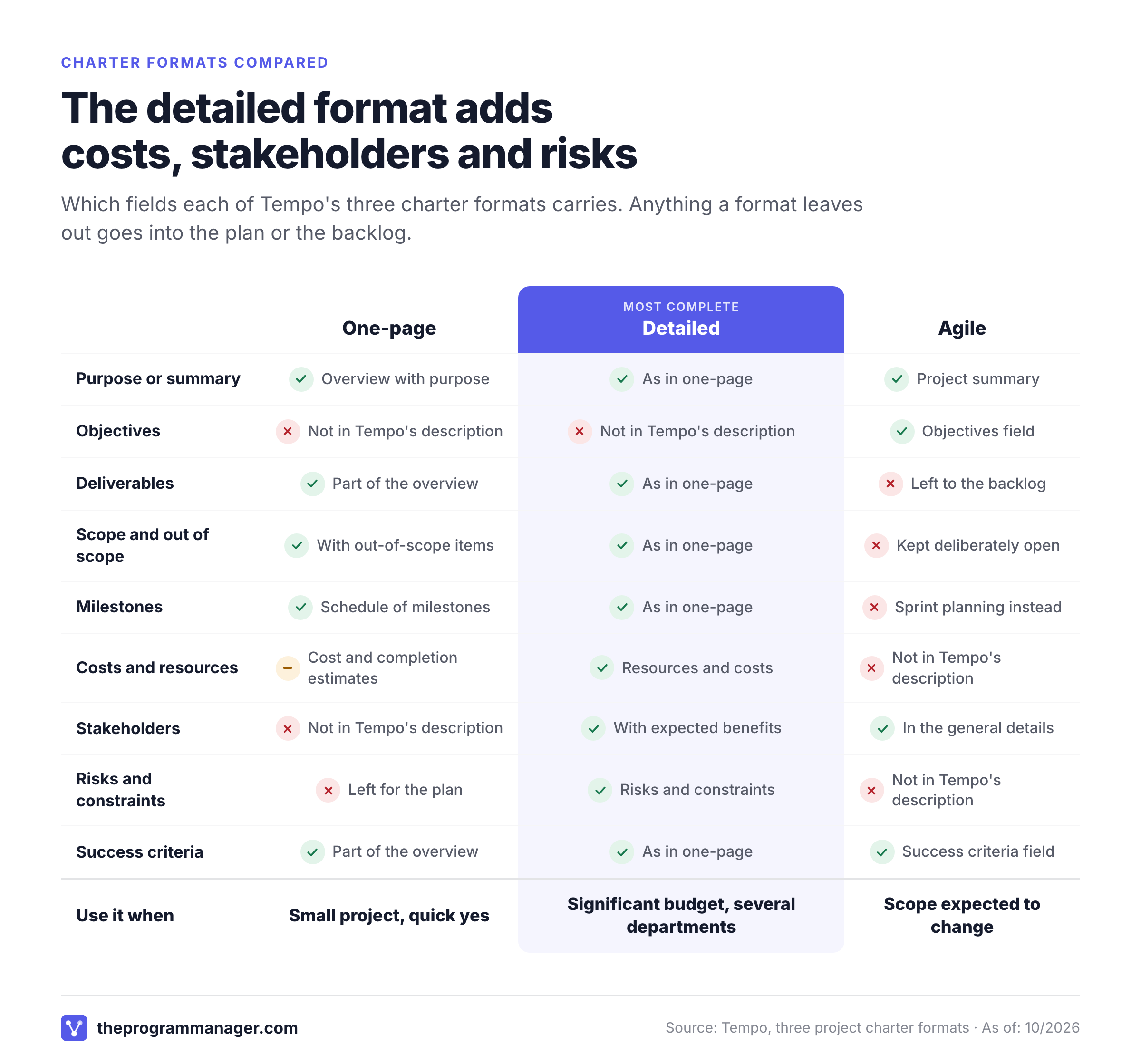
| Format | Use it when | What it leaves for the plan |
|---|---|---|
| One-page | The project is small, the team is small and a sponsor needs a quick yes | Detailed costs, resource schedule, full risk list |
| Detailed | The project has a significant budget, several departments or formal approval steps | Task-level schedule, detailed work breakdown |
| Agile | Scope is expected to change and the team works in short iterations | Backlog and sprint planning |
The template above sits between the one-page and detailed formats. For a small project, delete the budget and resource rows. For a formal project, add a cost breakdown and link the risk row to a full risk register or a RAID log.
Agile Project Charter Example
An agile charter keeps to the fields Tempo lists for its agile format: general details such as the champion and stakeholders, a summary, objectives and success criteria. The example below is illustrative and made up by us.
| Field | Example (illustrative) |
|---|---|
| Project name and champion | Self-service reporting, with the head of analytics as champion |
| Summary | Give account managers a report they can run themselves instead of requesting one from analytics |
| Objectives | Replace the three most requested manual reports, and review the backlog with the champion every sprint |
| Success criteria | Account managers run the three reports without help, and request volume to analytics drops |
| Stakeholders | Account managers (users), analytics (builders), finance (data owner) |
The scope stays deliberately open. What the team builds next comes from the backlog, and the charter only fixes the purpose, the people and the measure of success.
Program Charter Template: What Changes at Program Level
A program charter authorizes a program manager to run a group of related projects, and it's anchored in benefits rather than in a single deliverable. The University of Waterloo's program charter template, a primary source we read on 23 October 2026, states the purpose clearly: it outlines what's to be done and authorizes the program manager to proceed and apply organizational resources, based on measurable objectives tied to a business need and strategic benefits.
Three details from that template separate it from a project charter.
- Each component project keeps its own charter. The template says every component project should have a charter that lines up with the program charter. The program charter shares the vision and builds agreement across the components.
- Benefits are named from the start. The template includes a benefit statement and a list of program benefits with measurements. It describes the list as an initial, high-level one, and the detail moves into a benefits register during the program.
- Success is measured on three levels. The template separates the success of the products or services delivered, the success of the outcome (benefits and vision) and the success of the process used to manage the program.
The sections of the Waterloo program charter are listed below, with what each adds to a project charter.
| Program charter section | What it holds | How it differs from a project charter |
|---|---|---|
| Program overview | A paragraph or two on the program and why it's run | Links to the business case instead of repeating it |
| Benefit statement and program benefits | The problem or opportunity and the expected benefits with measures | A project charter rarely lists benefits separately |
| Program vision and goal | The desired future state in one to three short sentences | Not a project charter field |
| Objectives, scope and success criteria | SMART objectives, what's in and out, criteria on three levels | Success is split across products, outcomes and process |
| Constraints | Restrictions on resources, schedule and scope, plus how flexible each one is | Adds a flexibility ranking for the three constraints |
| Components and milestones | The projects and initiatives, with approximate timelines | A project charter lists deliverables instead |
| Dependencies | Relationships between components and external dependencies | Rarely needed for a single project |
| Governance, budget, roles | Governance structure, budget allocation and funding authority, roles | Governance is explicit and funding is split across components |
| Approval | Formal authorization based on what's known at initiation | Same function, signed by the sponsor |
The template's next step after approval is a program management plan, a benefits register and a benefits realization plan, and the program risk register. Those are the program-level equivalents of the plan documents that follow a project charter. For the whole picture, see what is a program manager and our guide to program management.
Project Charter Checklist Before Sign-Off
Run this list before you send the charter for signature. If you can't tick an item, have that conversation with the sponsor first rather than after the signature.
- The purpose fits in two or three sentences and links to the business case
- Every objective has a measure and a date
- Scope lists what's out, not only what's in
- Every deliverable is something a person can check
- Each stakeholder has a role and a reason to be listed
- The sponsor and the person who decides on scope changes are named
- Budget is a range or a cap, not a cost plan
- Milestones are events the sponsor can verify
- Success criteria can be read after delivery
- The top risks each have an owner
- Assumptions and constraints are written down
- The sponsor's agreed to sign, and the signature block has names, roles and dates
Common Project Charter Mistakes
The mistakes below come from our reading of the sources above and from how charters tend to fail in practice, so treat them as judgment rather than research findings.
- Writing a plan instead of a charter. If it has task lists and weekly dates, it's a plan. Move that detail to the plan and keep the charter to what the sponsor needs to approve.
- Vague objectives. "Improve customer experience" can't be checked. Add a measure and a date, as in Morningmate's examples, or write that the baseline will be set first.
- No out-of-scope list. Without one, every adjacent request looks reasonable, even when it isn't.
- A sponsor who hasn't really agreed. A signature without a conversation gives you no authority when a department refuses to release people.
- Stakeholders listed without roles. A long name list doesn't tell anybody what to expect. Say who reviews, who approves and who is only informed.
- Filing it and forgetting it. Revisit the charter when scope questions come up. If the project has genuinely changed, update the charter and have the sponsor re-sign.
Teams that run many projects at once feel these mistakes more. A charter that isn't kept current is no help when a milestone in one project depends on another. We build The Program Manager for that situation: it maps dependencies across Jira and Asana and watches milestones for risk. It's not a charter writer or a portfolio suite, and signup is invite-only.
What is the purpose of a project charter?
A project charter formally authorizes the project and gives the project manager authority to use organizational resources. It also records, in one short document, why the project exists, what's in and out of scope, who's involved and who approved it.
What should a project charter include?
A project charter should include eight elements, according to Tempo: objectives, scope and deliverables, key stakeholders, high-level budget and resources, high-level risks and constraints, milestones and timeline, success criteria, and roles and responsibilities. Wikipedia also lists the project manager's authority and responsibilities.
Who writes and signs a project charter?
The project manager usually writes it, working with the sponsor and stakeholders. The sponsor approves it. The University of Waterloo's charter template says that if somebody else writes the charter, the manager still signs to confirm they'll run the project within the documented parameters.
What is the difference between a project charter and a project plan?
The charter authorizes the project and sets its boundaries at a high level. The plan describes how the work will be carried out, monitored and closed, and it's written after the charter is approved.
How long should a project charter be?
A project charter should be as short as lets the sponsor approve it and the team understand it. Many are one page. Tempo's detailed format is longer, and the right length depends on the project's size and your organization's approval process.
Can I use a project charter template in Word or Excel?
Yes, you can write a project charter template in Word or Excel. The PMBOK Guide doesn't prescribe a format, so Word, Excel, a Google Doc or a form all work. Copy or download the template on this page, replace the example values with your own details and remove the notes before you send it for signature.
Leave a Reply