Program management is the coordinated management of a group of related projects so that together they deliver benefits that running them one by one wouldn't. If you run a program, work inside one or you're deciding whether you need one, this guide covers what program management is, how it differs from project and portfolio management, how a program moves from idea to closure and where programs go wrong.
- A program is a set of related projects, plus the ongoing change work around them, managed together for one business benefit. The projects deliver outputs; the program delivers the outcome they were funded for.
- Plan.io puts the usual horizon at about 1 to 3 years for a program against 3 to 12 months for a project, and measures programs on long-term outcomes rather than on delivery of a single output.
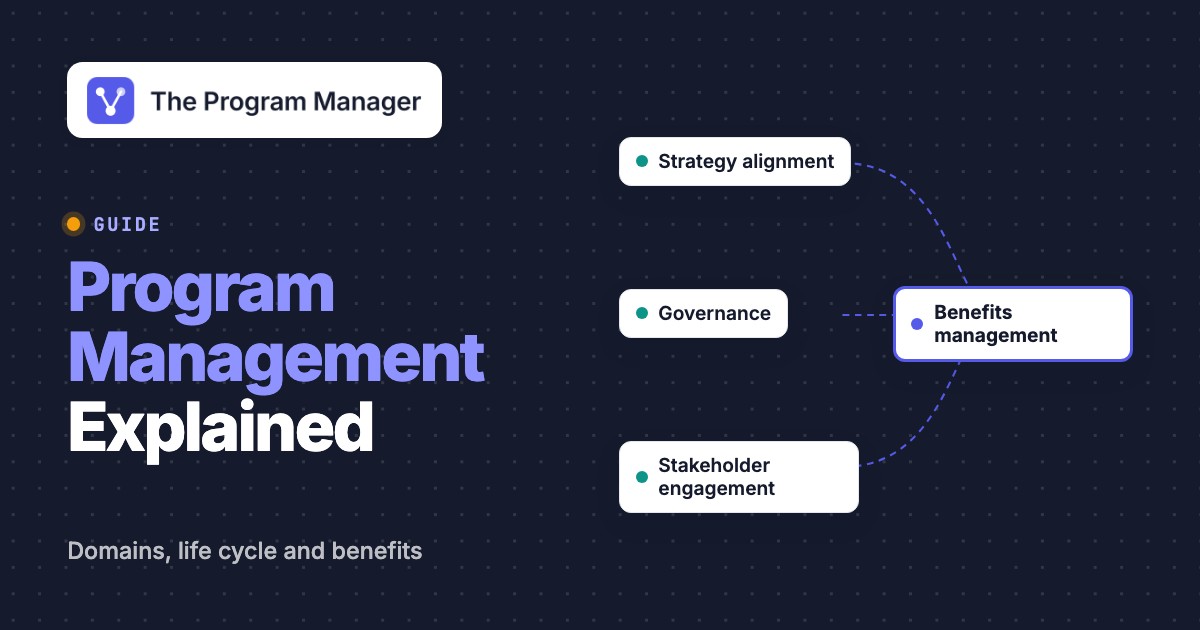
- PMI's Standard for Program Management organizes the work into performance domains. The fifth edition, published in 2024, adds Collaboration to the earlier set of strategy alignment, benefits management, stakeholder engagement, governance and life cycle management.
- You don't need a program just because you have many projects. You need one when the projects share dependencies, people or a benefit that no single project owns.
What Is Program Management?
Program management is the coordinated management of related projects, and the change activities around them, to achieve strategic benefits that managing each one separately wouldn't give. PMI describes a program as related projects, subsidiary programs and program activities managed together, and the publisher's description of the fifth edition of PMI's standard says program managers unite the efforts of related projects to create more benefits than the sum of their component parts.
Program managers now also use AI for status reports, risk lists and dependency checks, and our guide to AI project management shows what to hand over and what to keep.
If you want ready-made documents for each stage of a program, our collection of program management templates puts ten of them in order.
Mind Tools gives the most practical version: a program groups several projects that serve the same strategic goal and share a business sponsor. That sponsor clearly matters. A set of unrelated projects that happen to run at the same time isn't a program, because nobody's accountable for what they add up to.
Two details separate a program from a big project, although they're easy to miss. First, a program can contain work that isn't a project at all. Plan.io points to ongoing changes such as local process improvements, upskilling and product improvements that sit inside a program next to the projects. Second, a program doesn't end when the last deliverable ships. It ends when the benefit's been delivered and the structure is closed down, which can be months later.
Program Management vs Project Management vs Portfolio Management
A project delivers a defined output, a program combines projects and ongoing change to deliver an outcome, and a portfolio is the collection of programs and projects an organization has chosen to fund. The table sets the three side by side.
| Level | What it is accountable for | Typical horizon | Success is measured by |
|---|---|---|---|
| Project | One defined output with its own scope, schedule and budget | About 3 to 12 months (plan.io) | Delivering the output |
| Program | The combined outcome of several related projects and the change around them | About 1 to 3 years (plan.io) | Long-term outcomes and business benefits |
| Portfolio | Which programs and projects the organization funds at all | Ongoing, reviewed on a cycle | Whether the mix supports strategy |
The horizons are plan.io's typical figures, but they're not rules. Of course a program can run for five years and a small one for six months. What doesn't change is the question each level answers. The project asks whether the thing was delivered on time and on budget. The program asks whether the delivered things add up. The portfolio asks whether these were the right things to fund.
If you came here for the person rather than the discipline, our guide to program manager vs project manager compares the two roles in detail, and what is a program manager covers the job itself.
What Are the Performance Domains of Program Management?
PMI's Standard for Program Management groups the work into performance domains. The earlier editions name five: strategy alignment, benefits management, stakeholder engagement, governance and life cycle management. The fifth edition, published in 2024, adds a new domain, Collaboration, and reorganizes the content. It also states eight principles, and it aligns with the PMBOK Guide, Seventh Edition, according to the listing we read. PMI's own text for the fifth edition is not cited, so treat the exact domain list of that edition as something to check against the standard if you work to it.
Epicflow describes the same five areas as the components of a program management framework, and here's what each one means in practice. The table that follows shows what each looks like on the ground.
| Domain | The question it answers | What you can point to |
|---|---|---|
| Strategy alignment | Why does this program exist, and does it still fit the strategy? | A business case and a link from every project to the program's goal |
| Benefits management | What will be better, by how much and who owns that result? | A benefits register with an owner and a baseline per benefit |
| Stakeholder engagement | Who's got to change, approve or pay, and what do they need to hear? | A stakeholder list and a communication plan with owners |
| Governance | Who decides what, and how do issues escalate? | A steering group, decision rights and an escalation path |
| Life cycle management | Where's the program, and what has to be true to move on? | Phases with entry and exit criteria |
The right-hand column is our own reading of what each domain produces, not a quote from the standard. It's the quickest test of whether a program is really managed against a domain or only talks about it.
A Worked Example: A Billing Migration Program
This example is illustrative and made up by us, so the numbers are deliberately absent. A company is moving all customers to a new billing system. Four projects are funded: a data migration, a payments integration, a customer communication plan and a support training project. Each has a project manager and each could be delivered on time, but that alone doesn't make the launch work.
The program manager owns what none of those four own:
- The order. Payments can't be tested before the data is migrated, and customer emails can't go out before the cutover date is fixed. The program holds the plan that sequences all four.
- The shared people. The same two finance analysts are needed by the migration and the payments project in the same month. Only the program can decide who gets them first, while the project managers argue their own case.
- The benefit. The reason for the program is that invoices go out correctly from the new system and the old one can be switched off, and that's the benefit. No single project's accountable for that, so it has an owner at program level.
- The decisions that escalate. If the migration finds bad data and needs three more weeks, the program decides whether to move the cutover or cut scope elsewhere.
That split is the whole idea. The project managers keep their projects on track, but they don't see the whole picture. The program manager keeps the projects consistent with each other and with the benefit. For the cross-project risk side of this example, a RAID log and a shared risk register are the usual tools.
How Does the Program Life Cycle Work?
A program life cycle has three phases in the way ProjectManager.com summarizes PMI's standard: definition, benefits delivery and closure. Mind Tools lays out a finer-grained version for a delivery program, from strategy and business case through preparation, design, development and testing, training and business readiness, to support and benefits realization. The steps below combine the two and add the decision a sponsor takes at each point, which is our own framing, so don't expect to find it in either source.
Define the program
Set the strategy and business case, name the sponsor, agree the benefits you expect and appoint the project managers. Set up governance and write the program charter.
Deliver the projects and the change around them
The projects run inside the framework the program sets: shared principles, constraints, phase dates and entry and exit criteria. The program tracks dependencies, shared resources, budget and escalated risks.
Prepare the business to use the result
Training, communication and business readiness happen before the benefit can appear. A system nobody's ready to use actually delivers nothing.
Realize and sustain the benefits
Measure the benefits against the baseline you set in step one. Support the new way of working until it holds without the program.
Close the program
Hand over what remains, release the people and shut down the governance. Record what you would do differently.
Most failed programs skip step 3 or 4, and it's rarely a deliberate choice, although everyone intends to do them. The projects ship, yet the team disbands before anyone checks whether the benefit arrived.
Who Does What: Program Level vs Project Level
The cleanest way to see where the program ends and the projects begin is to list who owns each process. The table follows the split Mind Tools gives for a delivery program.
| Process | Program level | Project level |
|---|---|---|
| Phase management | Sets phase dates and approves entry and exit criteria | Manages the work inside each phase |
| Planning | Sets planning methods, the high-level plan and the critical path | Produces detailed plans and tracks progress |
| Control | Owns scope, business case, budgets, escalated risks, governance and reporting | Manages detailed scope, issues and risks, and escalates what it can't resolve |
| Team management | Manages shared resources and the project managers | Manages its own staff |
| Communications and change | Owns program-level communication and an integrated change approach | Handles local stakeholders and adoption |
| Integration | Manages the links between projects | Manages the links with business-as-usual functions |
Use the table as a starting point for a responsibility chart, but adapt the rows to your own program. If two rows in your own program have no owner, that's where decisions will stall, and you'll find out in the first conflict. A RACI chart is the usual way to write the answer down.
How Do You Manage Program Benefits?
You'll manage benefits by defining each one in measurable terms, giving it a named owner, recording a baseline before the work starts and measuring it again after delivery. Monday.com makes the same point in its best practices: focus on benefits from initial planning through post-implementation sustainment, define success metrics, set baselines and track progress against targets.
In practice this fits on one page. For the billing example, a benefit might read "invoices are generated correctly from the new system" with the finance lead as the owner and the current error rate as the baseline, which has to be measured before the work starts. If you can't name the baseline, you can't prove the benefit later, and nobody will take your word for it.
- Every benefit is written as a change someone can observe, not as a deliverable
- Each benefit has one named owner who isn't the program manager
- A baseline is recorded before delivery starts
- You know when and how each benefit'll be measured
- Each project is linked to the benefit it supports
- A benefit nobody owns has been dropped or reassigned
Program Management Best Practices
Good program management comes down to a few habits that tie the work back to the benefit, and they're simple to say but hard to keep. The list below merges monday.com's three practices with the points that follow from the sections above.
- Tie the program to strategic objectives. Monday.com says objectives should be measurable, time-bound and aligned with what the organization can actually do. If a project can't be linked to one, question why it's in the program.
- Align stakeholders and set a communication rhythm. Give each audience the information it needs at a fixed cadence, so the steering group isn't surprised.
- Focus on benefits from day one. Define them, baseline them, measure them.
- Manage the dependencies, not just the tasks. The reason to have a program is that projects depend on each other. Keep one list and review it every week.
- Decide who decides. Write down decision rights and the escalation path before the first conflict.
- Share resources deliberately. When two projects need the same people, the program decides who goes first and tells both.
- Review at phase gates and be willing to stop. A gate that never says no isn't a gate, and there's no point in holding one.
Thin or Thick: How Much Program Structure Do You Need?
Mind Tools describes two ends of the range, and most programs sit somewhere between them. The right amount of structure depends on how many dependencies you have and how hands-on the program manager must be.
| Thin program | Thick program | |
|---|---|---|
| Situation | Several projects pursue one strategic goal with few interdependencies, but the links that exist are critical | A new system rolled out across several business units in different regions, from design and build to pilot |
| Team | A sponsor, a program manager and one support person for reporting, costs, benefits, communication and meetings | A hands-on program manager and a program office with strategy and control roles |
| Program manager's work | Leads the overall change strategy and gives visibility to interdependencies | Directly manages design, build and implementation of core components and tracks rollout issues and risks |
| Skills that matter | Stakeholder relations, control of the whole program and leadership | Delivery depth plus governance |
Start thin and add structure when the dependencies demand it, not before. A program office built for a thick program will slow a thin one down, and it won't give you better control.
When You Do Not Need a Program
You don't need a program if your projects don't share dependencies, people or a benefit. Several projects under one executive is a portfolio, and a portfolio view with a regular review is still enough. This is our judgment, not a rule from a standard, and it's fine to disagree.
Ask three questions. Does one project's delay change another's plan? Do projects compete for the same people or budget? Is there a result that none of the projects owns alone? That's the test. If all three answers are no, adding program governance adds meetings without adding control. If one answer is yes and the rest are no, a shared dependency list and a monthly review may do the job without the full structure, whereas a full program would be overkill.
Why Programs Fail
Programs usually fail for a handful of reasons, and they show up long before the deadline. The list is our reading of the challenges plan.io describes and of the structure above.
- No benefit owner. The projects deliver and nobody checks the outcome.
- Hidden dependencies. Each team plans in its own tool, and the link between two plans lives in someone's head.
- A passive sponsor. Decisions that need the sponsor wait for weeks, so the program manager absorbs the delay.
- Role confusion. Plan.io notes that project, program and product manager roles get mixed up in small companies, and misunderstood roles can lead to failure.
- Misalignment with strategy. Work continues that no longer fits the goal, which causes rework.
- Too much structure. A heavy program office on a light program creates reporting nobody reads.
Plan.io also says program management isn't right for every organization, which matches the previous section.
Who Runs a Program and Which Tools Help?
A program is led by a program manager, often with a program office for reporting, costs, benefits and meetings. The role, the pay and the path in are covered in what is a program manager, and engineering-heavy programs have their own variant in the technical program manager guide.
Program managers mostly work across the tools their project teams already use, such as Jira or Asana, plus a document or slides for reporting. The gap is the layer above them: each project tool shows its own tasks, and none shows the dependency that crosses two of them. Our guide to the best program management software compares the tools built for this, and best project management software covers the level below.
We build The Program Manager for that gap: it maps dependencies across Jira and Asana, watches milestones for risk and keeps blockers and decisions in one place. It'sn't a full portfolio suite, and signup is invite-only, so it fits only when your program already spans those tools.
What is program management?
Program management is the coordinated management of a group of related projects so that together they deliver benefits that managing them separately wouldn't. It adds dependency management, shared resources, governance and benefits tracking on top of the individual projects.
What does program management do?
It sets the strategy and business case for the program, sets up governance, plans the order of the projects, manages the shared budget and resources, tracks dependencies and risks across projects, keeps stakeholders informed and checks that the intended benefits arrive.
What are the pillars of program management?
PMI's Standard for Program Management is organized into performance domains. The earlier editions name strategy alignment, benefits management, stakeholder engagement, governance and life cycle management, and the fifth edition from 2024 adds Collaboration.
Is it programme manager or program manager?
Both are correct, but the spelling differs by region. Programme is the usual spelling in British English and program is the usual spelling in American English. This blog uses the American spelling.
How is program management different from project management?
A project delivers one defined output on a set scope, schedule and budget. A program combines several related projects and ongoing change to deliver an outcome. Plan.io gives typical horizons of about 1 to 3 years for programs and 3 to 12 months for projects.
Do I need program management for every set of projects?
No. You need it when the projects share dependencies, people or a benefit that no single project owns. If they don't, a portfolio view with a regular review is usually enough.
Leave a Reply