Project dependency mapping shows which deliverables, decisions and teams must move before other work can proceed. A useful map names the supplying owner, the receiving owner, the handoff condition and the date that matters. It doesn't stop at drawing arrows between tasks.
For a project manager, the map makes sequence visible. For a program manager, it reveals where a local delay becomes a problem for another team, another project or a shared launch. A practical approach combines a simple dependency diagram with a register that people can update without redrawing the entire plan.
- Draw arrows from the supplying work to the work that depends on it.
- Record the owner, acceptance evidence, needed-by date and recovery action for each handoff.
- Label each dependency by type: sequence, external input, resource constraint or approval gate.
- Review changes across the entire downstream chain, not just the affected task's direct successor.
- Use a register for accountability and a map for understanding the sequence; neither one's enough alone.
What is project dependency mapping?
Project dependency mapping is the process of identifying, documenting and visualizing relationships that determine when work can start, finish or be accepted. A dependency connects a predecessor, which supplies something, to a successor, which needs it. The map should make the direction and the condition of that relationship unambiguous, so nobody has to guess what's expected.
A project schedule might say that testing follows development. A dependency map goes further, and that's where it earns its place: the test lead needs a deployable build, agreed test data and an environment that's available on the required date. If one of those conditions belongs to another team, the map should name that team's owner and the receiving owner.
The Project Management Institute (PMI) describes activity-on-node scheduling diagrams as activities represented by nodes and relationships represented by arrows. A map can use the same logic without pretending every organizational handoff is a precisely estimated schedule activity. The PMI explanation of schedule networks is a useful reference for formal scheduling terminology.
A dependency map isn't the same thing as a work breakdown structure. The work breakdown structure lists what work exists. The dependency map identifies which parts constrain other parts. A project can have a complete task inventory and still have a weak map if the handoffs aren't agreed.
How do you create a project dependency map?
Create a project dependency map by selecting the milestones that matter, identifying predecessor relationships, validating each handoff with its owners and recording how delays will be handled. You can start with a whiteboard, but the final record needs stable IDs and a review cadence.
Set the boundary
Choose the launch, decision or deliverable you're protecting. Include upstream work from other teams when its failure would change that outcome.
List the meaningful nodes
Write down accepted deliverables, approvals, external inputs and milestones. Avoid adding every small task from every team's board.
Connect predecessor to successor
Draw an arrow from the supplying node to the dependent node. Label the relationship when finish-to-start isn't the right model.
Confirm the handoff
Ask both owners what evidence proves the input is usable, when it must arrive and who can approve a workaround.
Add risk and response
Mark uncertain dates, external constraints and decisions that could affect several downstream nodes. Assign the next action to a person.
Review the map against live plans
Compare the register with source project schedules at a fixed cadence and whenever a major milestone moves.
Start with the outcome, not the entire task backlog
The outcome boundary decides which dependencies belong on the map, and it's the first call to make. If the goal is a pilot launch, include the work that can prevent that pilot. Don't copy an unrelated maintenance backlog just because it uses the same engineering team. That backlog isn't part of the outcome you're protecting.
A useful first pass begins with the launch milestone and works backward from it. Identify what must be true right before launch, then what those inputs need in turn. Stop when you've reached work that the team can treat as a stable input or a separately managed risk. That's your boundary.
Validate arrows with the people on both ends
A dependency arrow is an agreement. It's not an assumption by the PMO. The supplying owner confirms what they'll deliver. The receiving owner confirms what counts as acceptable and how much lead time is needed to use it.
For example, an API team may call an interface complete once its specification is approved, while the data team's real need is a working endpoint and sample data. Until those definitions match, the arrow is a negotiation, and it's not yet a dependable schedule relationship.
Keep the diagram readable
A readable dependency diagram uses a consistent arrow direction, stable node names and enough grouping to distinguish projects. Place suppliers to the left and receivers to the right. Add color for risk or status only once you've documented the meaning in a legend.
When a map becomes a wall of crossing lines, split it by release, program outcome or workstream. Keep a separate register so the split views still refer to the same dependency IDs. The diagram is a conversation aid, and the register is the record of commitments that people update.
Which project dependency types should you map?
Project dependency types include sequencing relationships, external inputs, discretionary sequencing, resource constraints and approval gates. Formal scheduling tools also distinguish finish-to-start, start-to-start, finish-to-finish and start-to-finish relationships. The category and the scheduling logic answer different questions, so keep them in separate fields.
| Project dependency type | What the relationship means | Example | What to verify |
|---|---|---|---|
| Mandatory sequencing | Work can't proceed without an input | Security test needs a deployable build | Required acceptance evidence |
| Discretionary sequencing | A chosen process places work in order | Training follows a content review | Whether overlap is safe |
| External dependency | A party outside the project supplies an input | Vendor delivers test credentials | Commitment and contingency |
| Resource constraint | Two activities need the same scarce capacity | Shared database specialist supports two teams | Allocation decision |
| Approval gate | A decision is required before release | Privacy lead accepts the data flow | Named decision maker and criteria |
The distinction matters because it's the recovery action that changes. A mandatory technical dependency may require replanning. A discretionary sequence might be safely overlapped. A resource conflict often needs a priority decision, while an approval gate needs evidence and an accountable approver.
The PMI article on schedule limitations discusses mandatory versus optional dependencies and the option of replacing an overly restrictive finish-to-start link with finish-to-finish or start-to-start logic. Don't relax a genuine safety or compliance requirement just to improve a forecast. Those requirements are non-negotiable.
How do FS, SS, FF and SF dependencies differ?
FS, SS, FF and SF describe which start or finish event constrains another activity. They don't tell you who owns the handoff or whether an input is accepted, so the map still needs operational fields.
| Project dependency logic | Plain-English meaning | Practical example |
|---|---|---|
| FS, finish-to-start | Successor starts after predecessor finishes | Pilot starts after test sign-off |
| SS, start-to-start | Successor starts after predecessor starts | Documentation begins after implementation begins |
| FF, finish-to-finish | Successor finishes after predecessor finishes | Final training guide waits for final interface behavior |
| SF, start-to-finish | Successor can't finish until predecessor starts | Old coverage ends after new coverage begins |
The PMI scheduling guide explains these relationships. FS is easy to understand, but it's not automatically correct for every overlap. If a project uses SS or FF, write down the actual start or completion condition rather than relying on an abbreviation alone.
What does a completed project dependency map look like?
A completed project dependency map shows the sequence of work, the handoff owners and the decisions needed to protect a milestone. The fictional product launch below demonstrates how a diagram and register work together. Every name and date in the example is illustrative, not a benchmark or a real delivery commitment.
Fictional launch scenario: a platform team supplies an API contract, a data team instruments analytics, an enablement team prepares training and a privacy lead approves the data flow. Operations can't begin the pilot until the required inputs are accepted.
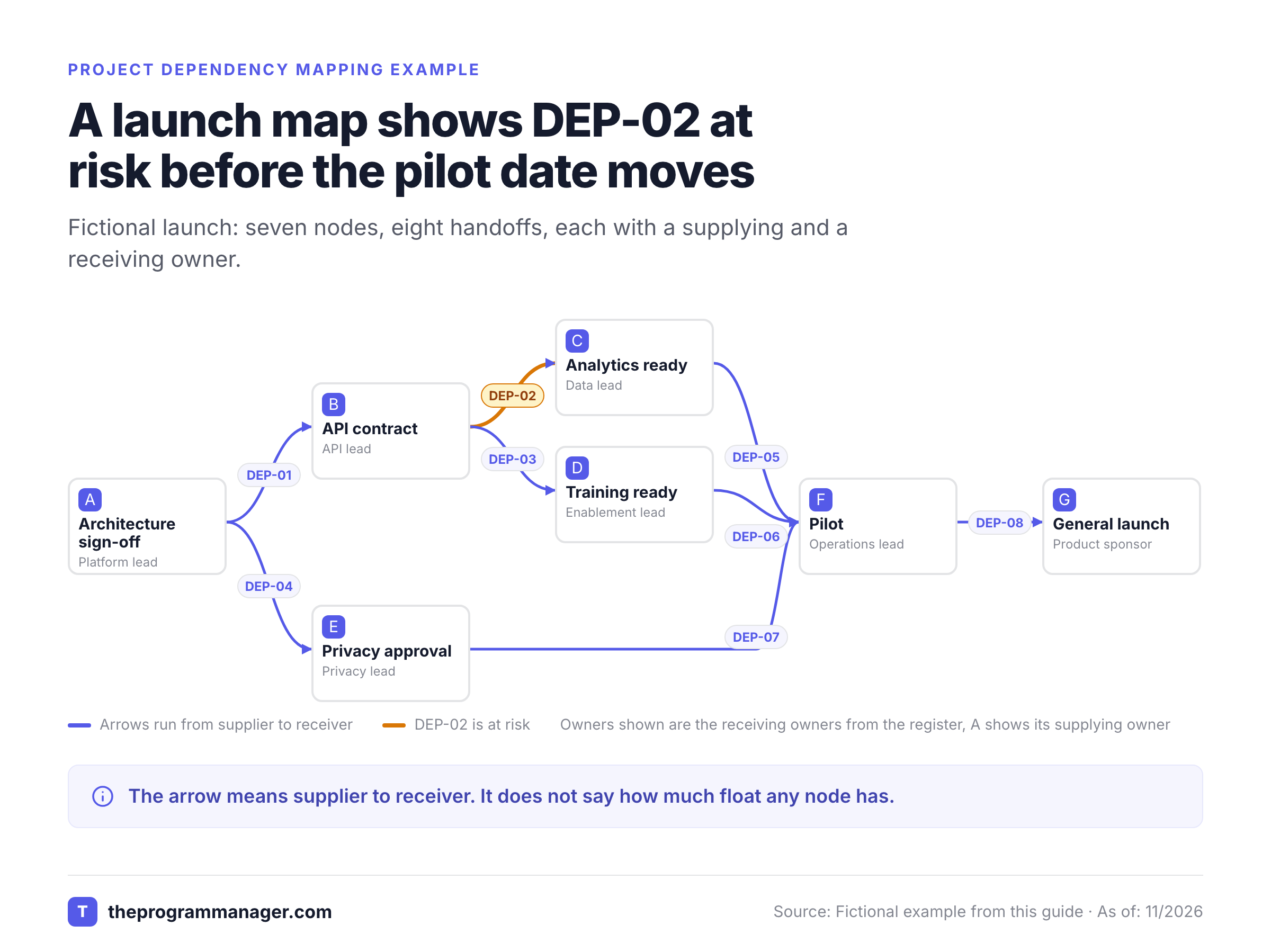
The arrow direction means supplier to receiver. The diagram doesn't imply that B, C, D and E require equal effort or have equal schedule float. It just shows the handoffs in this fictional scenario, and it's not a schedule.
| Project dependency ID | Supplier node | Receiver node | Supplying owner | Receiving owner | Needed by | Acceptance evidence | Status |
|---|---|---|---|---|---|---|---|
| DEP-01 | A Architecture sign-off | B API contract | Platform lead | API lead | Nov 12 | Architecture decision recorded | Accepted |
| DEP-02 | B API contract | C Analytics ready | API lead | Data lead | Nov 17 | Event contract and sample payload accepted | At risk |
| DEP-03 | B API contract | D Training ready | API lead | Enablement lead | Nov 18 | Interface behavior confirmed | On track |
| DEP-04 | A Architecture sign-off | E Privacy approval | Platform lead | Privacy lead | Nov 19 | Data-flow review accepted | On track |
| DEP-05 | C Analytics ready | F Pilot | Data lead | Operations lead | Nov 23 | Pilot dashboards reviewed | Not started |
| DEP-06 | D Training ready | F Pilot | Enablement lead | Operations lead | Nov 23 | Pilot team training confirmed | Not started |
| DEP-07 | E Privacy approval | F Pilot | Privacy lead | Operations lead | Nov 23 | Pilot readiness decision signed | Not started |
| DEP-08 | F Pilot | G General launch | Operations lead | Product sponsor | Dec 1 | Pilot exit criteria accepted | Not started |
The sample makes a hidden issue visible: DEP-02 is at risk even though the pilot milestone hasn't moved yet. Operations should ask whether a smaller analytics scope can meet the pilot's acceptance criteria, rather than waiting for the data team to mark its task late.
How should a delayed dependency propagate through the map?
A delayed dependency should trigger an impact check on every downstream node that relies on it, directly or indirectly. In the example, a delay to B can affect C and D, then F and G. The map shows the possible paths, but only an updated schedule and an agreed recovery plan can establish the actual date impact. That's why the register records the forecast.
A useful impact review records the new forecast, whether the receiver can work with a partial input, the remaining float and the decision owner. Don't automatically add the same delay to every downstream milestone, since that's rarely how a schedule behaves. Some activities can overlap, some have buffer and some require a new approval.
If a supplier misses its date, record the forecast and reason first. Then have the receiving owner describe the consequence. A PMO can coordinate the escalation, but it shouldn't silently change another team's acceptance criteria to keep the dashboard green.
Which fields belong in a dependency mapping template?
A dependency mapping template needs stable IDs, predecessor and successor references, two owners, a needed-by date, an acceptance condition, status and the next action. Add a decision owner when the recovery requires authority beyond either delivery team. The template below is intentionally a register, not a duplicate project plan.
Copy the register into a spreadsheet or download the file, then replace the fictional rows with real commitments. Keep the column headers as they are, and write dates in ISO format so they sort correctly.
Project dependency mapping register
One row per handoff, using the first three fictional rows from the example above. Replace the grey rows with your own commitments and keep the IDs stable.
| Dependency ID | Supplier node | Receiver node | Supplying owner | Receiving owner | Needed by | Acceptance evidence | Status | Next action | Decision owner |
|---|---|---|---|---|---|---|---|---|---|
| DEP-01 | A Architecture sign-off | B API contract | Platform lead | API lead | 2026-11-12 | Architecture decision recorded | Accepted | Archive approval evidence | Program manager |
| DEP-02 | B API contract | C Analytics ready | API lead | Data lead | 2026-11-17 | Event contract and sample payload accepted | At risk | Confirm fallback event set | Product sponsor |
| DEP-03 | B API contract | D Training ready | API lead | Enablement lead | 2026-11-18 | Interface behavior confirmed | On track | Review training draft | Enablement manager |
What belongs in the status field?
The status field should describe the handoff, not the general health of the supplying project. Use Not started, On track, At risk, Blocked and Accepted. A task can be marked done in a source tracker while its dependency remains blocked because the receiving team rejected the output.
An accepted dependency should link to evidence: an approval record, test result, signed decision or a receiving-owner confirmation. The register doesn't need to store the evidence itself, but it must point to the right record in the team's system.
What makes the template useful across projects?
A cross-project template stays useful when every dependency has an ID that survives changes to task titles or board locations. Put the source task link in your working spreadsheet if your organization needs it. Don't make a brittle text label the only way to find the work.
Agree on who updates the status and who challenges it. The supplier can report progress, but the receiver decides whether the handoff is usable. That's the rule that keeps a green status honest. The program manager owns the cross-project view and escalates unresolved conflicts to the sponsor or designated decision maker.
How do you find critical dependencies and bottlenecks?
Find critical dependencies by checking which relationships constrain important milestones, have little schedule flexibility or depend on uncertain outside decisions. A crowded node deserves attention, but a high number of arrows doesn't by itself make that node part of the critical path.
The critical path is a schedule calculation based on activity durations and logical relationships. PMI explains that total float measures how long an activity can move without delaying project completion. A handoff register alone doesn't contain enough information to calculate a reliable critical path. Use the schedule network for that calculation and the map to make the ownership and acceptance risks visible.
A practical triage starts with three checks. First, find out whether the receiver needs the full output or can accept a smaller usable slice. Second, confirm that the supplier's date is a commitment and not just a forecast. Third, name who's allowed to choose between re-sequencing, adding capacity and moving the milestone.
| Project dependency signal | Interpretation | Response |
|---|---|---|
| Many receivers depend on one supplier | A shared upstream exposure | Confirm capacity and staggered handoffs |
| Acceptance evidence is missing | Completion may not equal readiness | Agree on acceptance criteria |
| Needed-by date precedes the supplier forecast | A timing conflict exists | Replan or escalate a decision |
| External input has no committed date | Forecast confidence is weak | Obtain commitment or contingency |
| Two-way dependency between nodes | The plan may contain circular logic | Split deliverables or change sequencing |
A circular dependency deserves a look right away, because it's a sign the plan can't work as drawn. If team A can't finish until team B finishes and team B can't finish until team A finishes, the plan needs a different handoff definition or a staged deliverable. Adding more arrows won't solve a logical deadlock.
How should a PMO maintain cross-project dependency maps?
A PMO should maintain one cross-project dependency register, with source teams accountable for their commitments and receiving teams accountable for acceptance. The review cadence should match the pace of change. A stable quarterly initiative may need fewer updates than an active launch approaching its cutover.
Start each review with changed milestones and blocked handoffs, not with every green row, since that's where the decisions are. Ask the supplier what's changed, the receiver what it affects and the decision owner what trade-off is required. Then update the register and ask each team to update its own source plan so the two don't drift apart, because a team's plan is still the authority on its own dates.
- Every dependency has a stable ID and clear arrow direction.
- Supplying and receiving owners agree on the acceptance condition.
- Needed-by dates match the current source plans.
- At-risk handoffs have a named next action and decision owner.
- Downstream impacts have been checked beyond the immediate receiver.
- Accepted handoffs point to evidence, not just a completed task.
Who owns an inter-project dependency?
An inter-project dependency needs a supplying owner and a receiving owner. The supplying owner is responsible for delivering the input; the receiving owner confirms whether it meets the agreed condition. A program manager coordinates the shared view and escalates trade-offs that neither team can resolve.
The Association for Project Management's Gantt guidance notes that timelines can show dependencies and task ownership. A cross-project dependency register adds a second ownership perspective: who provides the input and who must accept it. That's a useful distinction when projects use different tools or reporting calendars.
How do you report a dependency to executives?
An executive dependency update should name the threatened outcome, the decision needed, the latest safe decision date and the options. Don't paste a full diagram into a steering committee pack when the real issue is a single unresolved capacity trade-off. The committee's time is better spent on the decision.
For the fictional pilot, a useful escalation would say that analytics acceptance is at risk, the pilot readiness decision depends on it and the sponsor must choose between a reduced event set and a revised pilot date. That statement supports action, and it's short enough to read aloud. A red status icon without an owner or option doesn't.
Which tools can you use for project dependency mapping?
Project dependency mapping tools range from whiteboards and spreadsheets to scheduling software and cross-project tracking systems. Choose based on the question you're answering: discovery, schedule logic, acceptance tracking or ongoing monitoring. A tool that draws attractive arrows isn't necessarily a reliable source of live milestone status.
| Project dependency mapping need | Useful format | Main limitation |
|---|---|---|
| Discover hidden handoffs in a workshop | Whiteboard or diagram | Requires follow-up ownership and updates |
| Track commitments across teams | Shared register | Doesn't calculate a critical path |
| Model schedule relationships | Network or Gantt schedule | Can miss operational acceptance gates |
| Watch changing cross-project milestones | Linked source plans and dependency view | Requires consistent IDs and governance |
For teams working in Jira and Asana, a shared dependency view should preserve each team's authoritative task status. The right monitoring layer flags changed milestones and missing handoffs without becoming a second place to maintain every task.
Don't promise that a tool will resolve the organizational issue. Software can flag a changed date or a broken link, but it can't decide what's acceptable. The receiving team still needs to decide whether the input is acceptable, and the sponsor still needs to approve material trade-offs.
What mistakes make dependency maps unreliable?
Dependency maps become unreliable when they confuse activity completion with handoff acceptance, omit external decisions or stop updating after planning. The common failure isn't a missing visualization feature. It's an arrow that nobody has agreed to own.
Too much detail: A map that includes every tiny task hides the relationships that can move a milestone. Keep detailed work in source boards and use the map for the handoffs that matter. That's where a late input actually changes a milestone.
One-sided ownership: A supplier marks its work complete, but nobody confirms the receiver can use it. Name both owners and make acceptance explicit, because it's the receiver who knows what's usable.
Invented precision: A visually neat diagram implies a critical path without durations, calendars or validated relationships. Treat the picture as a dependency model, not a scheduling calculation.
Status without a response: A red node remains red for several meetings because nobody has authority to change the plan. Add the next action, decision owner and deadline for escalation.
Missing outside inputs: Vendor dates, legal reviews and customer decisions never reach the map, so the plan only looks complete. Add every external input that can move a milestone and name an internal owner for it.
Stale snapshots: The register and the delivery boards disagree after a milestone changes. Choose an authoritative source for each field and reconcile changes at every review.
The simplest quality test is to give the map to someone outside the workstream. If that person can't clearly identify what is blocked, who must act and what decision is due, the map needs clearer handoffs rather than more decoration.
Frequently asked questions about project dependency mapping
Project dependency mapping works best when the team agrees on direction, ownership and acceptance. The questions below cover how a map differs from a schedule and who keeps each one current.
What is the difference between a dependency map and a Gantt chart?
A dependency map emphasizes which work relies on other work and who owns the handoff. A Gantt chart places scheduled activities on a timeline and can display dependency relationships.
Can you use a dependency map without a critical path?
You can use a dependency map without a calculated critical path. Critical path analysis needs a schedule network with durations and valid logical relationships.
Should you map external vendor dependencies?
External vendor dependencies belong on the map when their input can affect a project milestone. Record the commitment, receiving owner and fallback rather than assuming the vendor's date is guaranteed. You'll want that fallback ready before the date slips.
Who updates a cross-project dependency register?
A program manager or PMO can maintain the shared register while supplying teams update forecasts and receiving teams confirm acceptance. The sponsor resolves priority conflicts beyond the teams' authority.
How often should dependency maps be reviewed?
Review dependency maps when a consequential source milestone changes and at a regular cadence suited to delivery risk. Don't wait for the next scheduled meeting if a launch cutover is close. Active launches need more frequent attention than stable planning work.
Related operating guides can help turn the map into a working plan. Use the program management plan template for decision rights, the program roadmap template for milestone alignment and the project dependency matrix template when a dense network needs a square-grid view.
Leave a Reply