
A steering committee is the group that decides what a project or program does when the team can't decide it alone. It approves the budget and scope, clears blockers and says stop or go at the big checkpoints, and that's about all it does. This guide explains what a steering committee is, who sits on one, how it differs from a PMO or a project board, how often it should meet and how to run the meeting. It ends with a six-step setup plan and a short list of mistakes to avoid.
- A steering committee is a group of senior stakeholders that gives direction to a project or program, makes the decisions the team can't make and monitors progress against the goals.
- It doesn't manage tasks. The project or program manager runs the work, and the committee decides on scope, budget, priorities, risks that escalate and go or no-go points.
- Most committees have a chair or executive sponsor, a business owner, finance, a technical lead and a few subject experts, and they stay small enough that everyone speaks.
- Meet monthly for most programs, send the pre-read ahead and end every meeting with a written list of decisions and owners, because what isn't written down doesn't stick.
What Is a Steering Committee?
A steering committee is a group of senior stakeholders that provides direction, makes key decisions and monitors progress for a project, program or organization-wide initiative. Dilitrust describes it as a body that gives guidance, makes decisions and monitors progress on important initiatives, and that keeps a strategic view instead of working on daily tasks. Notion calls it an advisory board of leaders and external stakeholders, and that fits too, because in many organizations the committee advises first and then decides.
The name comes from the idea of steering a vehicle. The team drives, and the committee picks the route, so it's the committee that answers for where the work ends up. It doesn't touch the pedals. That's the real difference between a steering committee and the team it oversees: the committee owns the direction and the big trade-offs, while the team owns the work.
You'll also see it called a steering group, a steerco or a steer co. They all mean the same thing in practice, even though the formal names differ. PRINCE2 uses the term project board for the equivalent group, and the roles on it map closely to those described below.
What Does a Steering Committee Do?
A steering committee sets direction, approves money and scope, resolves what the team has escalated and checks that the work still serves the goal. It doesn't plan the tasks or run the daily stand-up. Dilitrust, Notion and Enov8 describe the same core responsibilities.
- Direction and alignment. It confirms that the project still supports the organization's goals and approves changes of course.
- Budget and resources. It approves the budget, releases funding in stages and settles conflicts over people and priorities between teams.
- Scope and change. It decides on changes to scope, timeline or cost that are bigger than the project manager's authority.
- Risk and escalations. It takes the risks and issues the team can't solve, for example a dependency on another department or a vendor delay. Our guide to the risk register shows what should reach this level.
- Go or no-go decisions. It signs off at the major checkpoints, such as approving the plan, starting a phase or launching.
- Communication. It carries the project's status upward to executives and the board, and carries decisions back down.
The first question to ask about any item is whether it needs a decision from people above the project team. If it doesn't, it shouldn't be on the committee's agenda at all.
| Belongs to the steering committee | Belongs to the project or program team |
|---|---|
| Approving or cutting the budget | Tracking spend against the approved budget |
| Choosing between two strategic options | Estimating and scheduling the tasks for the chosen option |
| Resolving a clash between two departments | Raising the clash early with the right evidence |
| Accepting a risk above the team's threshold | Logging, scoring and mitigating risks day to day |
| Deciding to launch, delay or stop | Preparing the launch and the readiness evidence |
What Is the Difference Between a Steering Committee and Other Governance Bodies?
A steering committee oversees one initiative or a defined set of them. People mix it up with other groups because they all sit above the delivery team, but each has a different job, so here's how they differ.
| Group | Scope | What it decides | How it differs from a steering committee |
|---|---|---|---|
| Steering committee | One project, program or initiative | Direction, budget, scope, go or no-go | Time-limited to the life of the work, with senior members |
| Governance committee or board | The organization or a whole function | Policy, standards, portfolio-level priorities | Permanent and broader, and often sets the rules a steering committee works within |
| PMO | Many projects | Methods, templates, reporting standards | A function that supports delivery, not one that owns it. It usually has no authority to approve funding. See what a PMO is |
| Executive sponsor | One initiative | Owns the business case and the outcome | A single person, who often chairs the committee |
| Project team | The work itself | How to deliver the tasks | Executes the committee's decisions |
| Advisory board | A topic or product | Nothing binding | Gives advice only. A steering committee holds decision rights |
The line between a steering committee and a governance committee is mostly about scope and permanence. A governance committee sets the framework for how projects are chosen and controlled, and it stays in place. A steering committee applies that framework to one initiative, then dissolves when the work ends. For the wider picture of how these layers fit together in a program, see our program management framework guide.
Who Sits on a Steering Committee?
A steering committee usually has an executive chair, a business owner, finance and technical representatives and a few subject experts, and it keeps the project or program manager in the room as the person who presents. The exact mix depends on what the initiative touches. Notion and Enov8 both note that a project committee may include client-side stakeholders, while an organizational one is more likely to hold executives and department heads.
| Role | What they do on the committee |
|---|---|
| Chair or executive sponsor | Runs the meeting, owns the business case and breaks ties |
| Business owner or senior user | Speaks for the people who will use the result and confirms it meets the need |
| Finance representative | Checks the budget, the forecast and the benefits |
| Technical or delivery lead | Judges whether the plan is feasible and flags technical risk |
| Functional heads (HR, legal, security, operations) | Represent the departments that the work affects |
| Subject matter experts | Advise on a specific topic, usually without a vote |
| Project or program manager | Reports status, brings the decisions to be made and records the outcomes |
Two guidelines hold up well. First, keep it small. Board-room.org, citing Deloitte research, puts the typical committee at five to ten members, and the point holds beyond that source: past about ten people, conversations turn into presentations. Second, and this matters more than it sounds, the chair shouldn't be the person who owns the project's delivery. Enov8 advises an impartial chair who doesn't own the project being steered, and that stops the committee from marking its own homework.
A related question is who counts as a member and who's just there to attend. Decide it in writing. A member votes or holds a decision right, an attendee gives input and leaves the decision to others. Writing that down saves arguments later, which is why the terms of reference in the setup steps below include it. If you're mapping who has influence over the work in the first place, our guide to the stakeholder map covers the power and interest scoring that usually picks the members.
What Are the Main Types of Steering Committee?
The type depends on the level it works at. Most steering committees fall into four groups.
- Project steering committee. It oversees one project and its budget, and it usually dissolves at closure.
- Program steering committee. It oversees several related projects and their shared dependencies, benefits and risks. It spends more time on trade-offs between projects than on any one project's detail. Our guide to program management explains the setup.
- IT steering committee. It prioritizes technology investments and checks that IT work matches business goals. Its members usually include the CIO, security, finance and business unit leaders.
- Executive or organizational steering committee. It steers a company-wide change, such as a merger integration or a transformation, and often reports to the board.
The structure doesn't change much across the four. What changes is how far up the organization the decisions go and how many initiatives sit under the committee.
How Often Should a Steering Committee Meet?
Most project and program committees meet monthly, and a few meet every quarter once the work is stable. Meet more often when the work is at a decision point or in trouble, but not so often that it becomes a status call, and less often when it's steady. There isn't a universal rule, so treat the table below as our suggested starting point, not a standard.
| Situation | Suggested cadence | Why |
|---|---|---|
| Project start, plan approval | Every two weeks until the plan is signed off | Many decisions arrive together |
| Steady delivery | Monthly | Enough to track milestones and approve changes |
| Large or high-risk program | Monthly, plus a short call when a decision can't wait | Keeps decisions from sitting for weeks |
| Stable, low-risk work | Every quarter | Review progress and benefits without adding overhead |
| Launch or major go or no-go | A dedicated session | One decision deserves the full meeting |
Between meetings, don't let decisions wait, even though it's tempting to save them for the next session. Agree up front that urgent items go to the chair by message or a short call, and that the outcome is recorded at the next meeting.
What Goes on a Steering Committee Agenda?
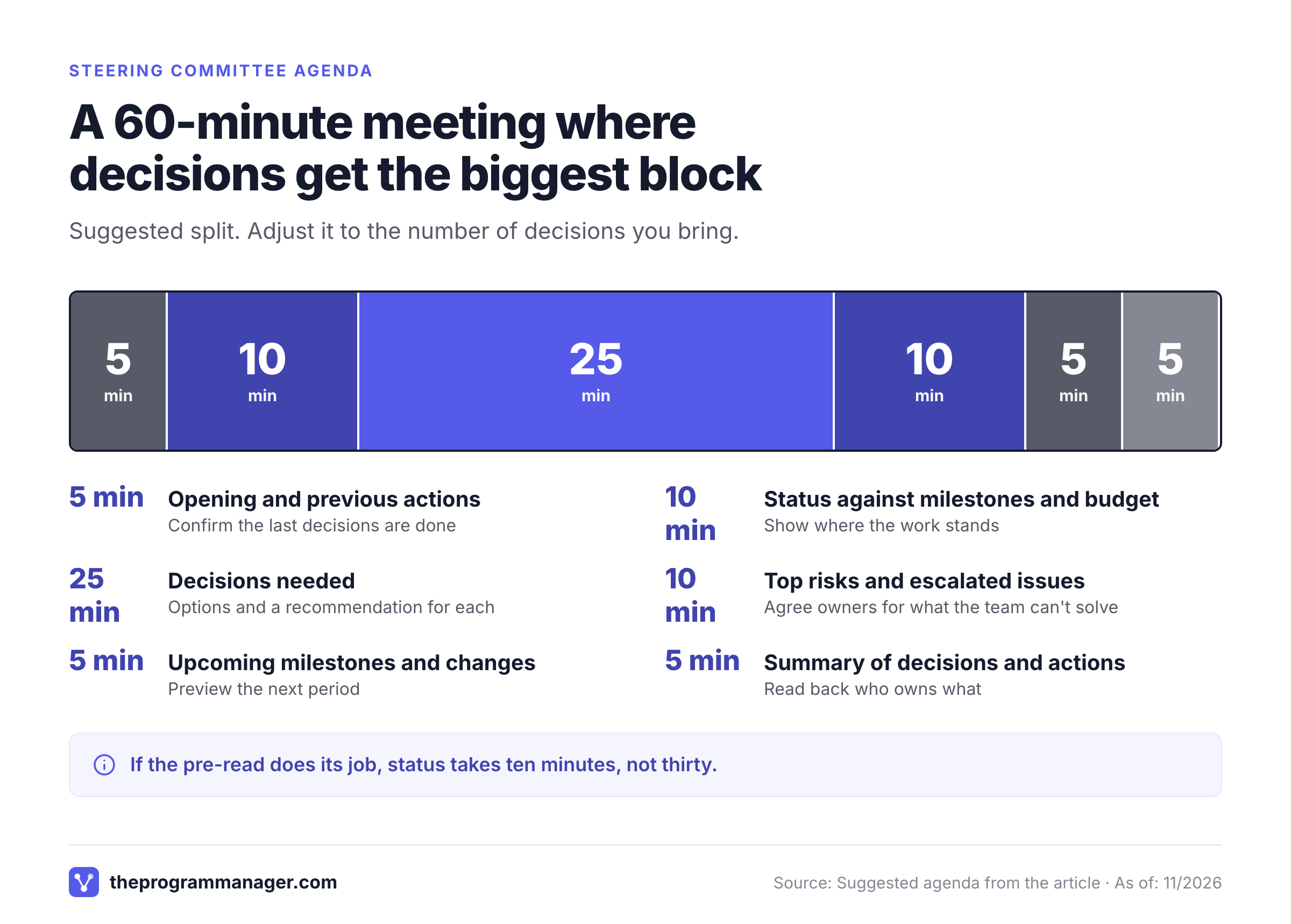
A steering committee agenda covers status, decisions, risks and what's next, in that order, with most of the time given to decisions. Cornerstone Dynamics advises sending a pre-read a few days ahead so that members arrive prepared, especially when you're asking them to remove a roadblock or give approval. The agenda below is for a 60-minute meeting. The times are our suggestion.
| Agenda item | Minutes | Purpose |
|---|---|---|
| Opening and previous actions | 5 | Confirm the last meeting's decisions are done |
| Status against milestones and budget | 10 | Show where the work stands, without reading the report aloud |
| Decisions needed | 25 | Present each decision with options and a recommendation |
| Top risks and escalated issues | 10 | Agree owners for the ones the team can't solve |
| Upcoming milestones and changes | 5 | Preview what the next period holds |
| Summary of decisions and actions | 5 | Read back what was decided and who owns it |
- One-page status: milestones, budget and the overall health rating
- Each decision stated as a question, with two or three options and a recommendation
- Top risks and issues with owners and the help needed from the committee
- Changes to scope, cost or timeline since the last meeting
- Actions from the previous meeting and their status
- Sent at least two working days before the meeting
The most common agenda failure is status reporting that eats the whole hour. Members can read the pre-read themselves, so the meeting should be for decisions. For the status page itself, our project status report template gives a one-page format you can adapt.
How to Set Up a Steering Committee in Six Steps
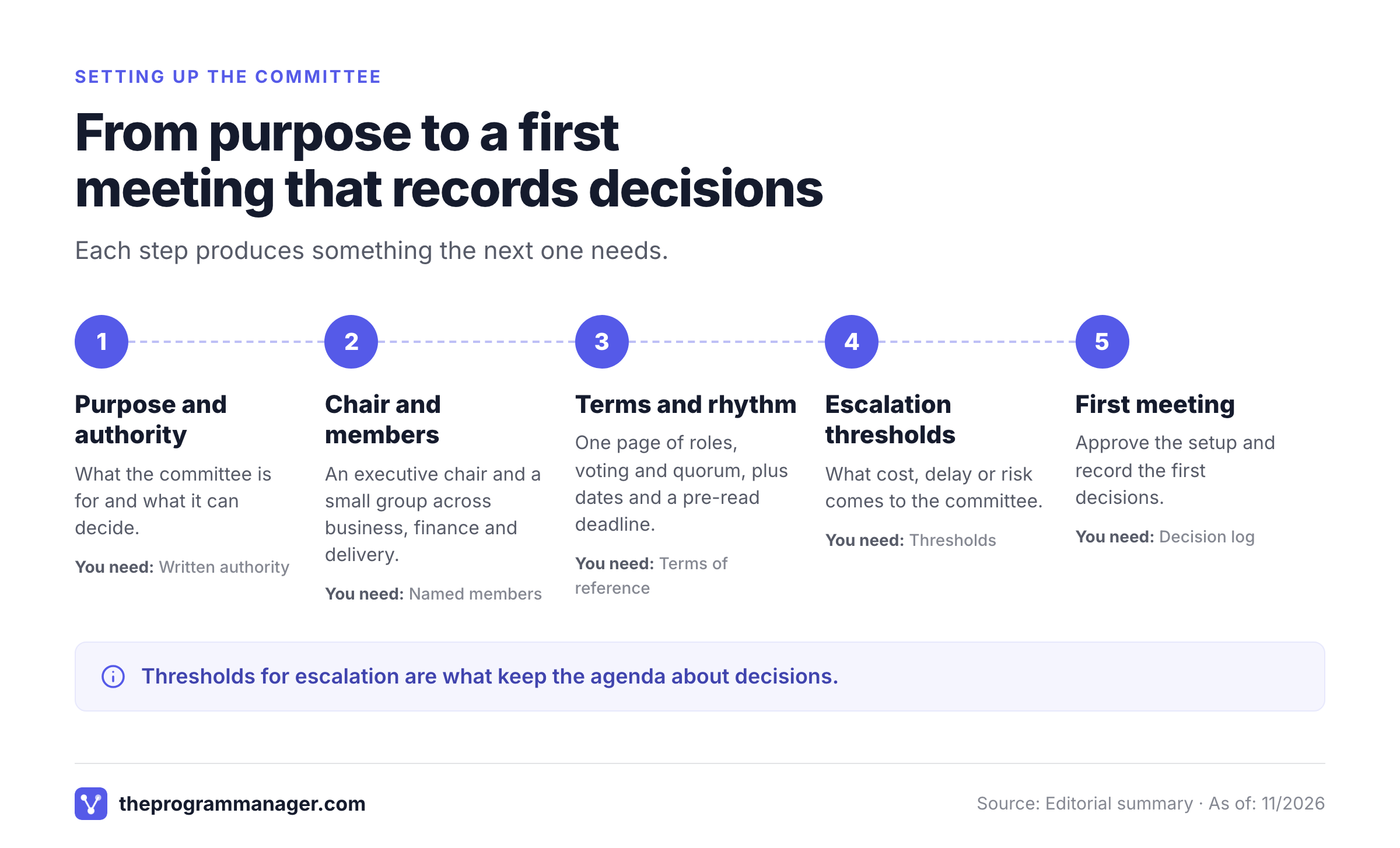
To set up a steering committee, agree its purpose and authority, choose a chair and members, write terms of reference, set the meeting rhythm, define what gets escalated and then hold a first meeting that approves all of it. The steps below follow that order.
State the purpose and the authority
Write one or two sentences on what the committee is for and what it can decide. Be specific about the limits. For example, it approves changes to scope and budget above a set amount and it can pause the work, but it doesn't assign tasks.
Choose the chair and the members
Pick an executive who can break ties and a small group that covers the business, finance and delivery sides. Keep the chair independent of the project's day-to-day work where you can, and name the people, not the departments.
Write the terms of reference
One page is enough. Include purpose, members and their roles, who votes, how decisions are made, quorum, meeting frequency and how the committee reports upward. The checklist below lists the minimum.
Set the rhythm and the pre-read rule
Fix the meeting dates for the next three to six months before anyone's diary fills up. Agree the pre-read deadline and a rule that decision items without a pre-read move to the next meeting.
Define what gets escalated
Set thresholds for what comes to the committee, such as a cost increase over a percentage, a delay to a named milestone or a risk the team rates above an agreed level. Without thresholds, either everything or nothing arrives.
Hold a first meeting that approves the setup
Use the first session to confirm the terms of reference, the thresholds and the cadence. End by recording the decisions and actions, so the habit starts on day one.
- Purpose and scope of the committee
- Named members, their roles and who has a vote
- Chair and a named deputy
- How decisions are made and what counts as a quorum
- Meeting frequency, length and the pre-read deadline
- Escalation thresholds for cost, time and risk
- Who takes minutes and when they're circulated
- How and when the committee is reviewed or dissolved
What Does a Steering Committee Decision Look Like?
A good steering committee decision is specific, recorded and owned. The example below is hypothetical. It's a decision log for a program that replaces a customer portal across three workstreams, and it shows what the committee's output should look like after one meeting.
| Decision | Options considered | Outcome | Owner | Due |
|---|---|---|---|---|
| Release phase two funding | Release now, release after security review | Release after the security review passes | Finance partner | Next meeting |
| Vendor delay on the login component | Wait, switch vendors, cut the feature from launch | Cut the feature from launch and add it to phase three | Workstream lead | Two weeks |
| Cross-team clash over test environments | Share one, fund a second | Fund a second environment from contingency | Executive sponsor | One week |
| Launch date | Keep the date, move by four weeks | Keep the date, review again at the next meeting | Chair | Next meeting |
Notice what's in the table, and what isn't: there's no discussion, only outcomes. Each decision names the options, the outcome, a person and a date. A decision without an owner is a wish, and it won't get done. If it's not written down, it didn't happen, and it'll be re-argued at the next meeting. For tracking the underlying items, a RAID log keeps risks, assumptions, issues and dependencies in one place, and a RACI chart clarifies who is responsible, accountable, consulted and informed on each deliverable.
Common Steering Committee Mistakes
Most steering committees fail in a few predictable ways, but each one is fixable if you spot it early.
- Too many members. Once a committee passes ten or so, it's hard to hear everyone, and nobody has time to speak, and decisions drift to the loudest voice. Move the extra people to attendee status.
- No clear authority. If the committee can't approve anything, it turns into a status meeting. Write down what it can decide, because you'll need that list the first time someone asks why it's involved.
- Status updates instead of decisions. Read the pre-read before the meeting and use the time for choices. If there's nothing to decide, cancel the meeting.
- The wrong people. Delegates who have to "check with my boss" stall decisions. Ask for the person with the authority, or give the delegate decision rights in writing so they aren't stuck.
- No follow-through. Decisions that aren't recorded and tracked come back the next month. Send a short decision summary within a day, while everyone still remembers what they agreed.
- Surprise items. Members shouldn't hear about a major risk for the first time in the meeting. Brief the chair and the people affected beforehand, since nobody likes being ambushed.
Where the Program Manager Fits
The program manager prepares the committee's pre-read, brings the decisions that need making and tracks what's been agreed. They aren't a voting member in most setups, since they report on the work rather than judge it. To do that well, you'll need an accurate picture of milestones and dependencies across teams. For the role in full, read what a program manager does, and for the plan the committee approves, see our program management plan template and project charter template.
The Program Manager doesn't run steering committees. It maps dependencies across Jira and Asana and watches milestones for risk, which gives the program manager the evidence for the status and risk sections of the pre-read.
What is a steering committee in simple terms?
A steering committee is a group of senior people who guide a project or program. They approve the budget and scope, resolve problems the team can't solve and decide at major checkpoints whether the work goes ahead.
What does steer co mean?
Steer co is an informal short form of steering committee, also written steerco. It refers to the same senior group that oversees a project or program.
What is another name for a steering committee?
Common alternatives are steering group, steerco and project board. PRINCE2 uses project board for the group that holds equivalent decision rights.
What is the difference between a steering committee and a governance committee?
A governance committee is permanent and sets the policies and standards for a function or the organization. A steering committee oversees one project, program or initiative and usually ends when the work ends.
What is the role of an IT steering committee?
An IT steering committee prioritizes technology investments and checks that IT projects support business goals. Members typically include IT leadership, finance and leaders from the business units that use the systems.
Who should chair a steering committee?
The chair is usually the executive sponsor or another senior leader who can make and enforce decisions. Where possible, choose someone who doesn't own the day-to-day delivery, so the committee can challenge the plan.