A PMO, short for project management office, is the group in an organization that sets how projects are run and helps teams follow it. This guide explains what a PMO does, the three classic types, who works in one, when a company needs one and how to set one up without creating a layer of paperwork.
- A PMO (project management office) is a team or function that standardizes, supports and governs how an organization runs projects, programs or a whole portfolio.
- PMBOK describes three types by level of control: supportive, controlling and directive. Many organizations also describe PMOs by scope, such as departmental or enterprise.
- The core work is governance, standards, intake and prioritization, reporting, resource coordination, risk tracking and training.
- A PMO pays off when several projects compete for the same people and leadership can't see the whole picture. A company with two or three projects rarely needs one.
What Is a PMO?
A PMO is a project management office: a team, department or function that defines project management standards, supports the people who deliver projects and reports on how the work is going. The PMBOK Guide from the Project Management Institute (PMI) describes the PMO as a management structure that standardizes project-related governance and makes it easier to share resources, methods, tools and techniques.
The letters can also stand for a program management office or a portfolio management office. The first looks after a group of related projects that share a goal, and the second looks across everything the organization funds. Many companies simply use "PMO" for whichever one they have. If you're unsure which one a job ad or a policy document means, check whether it talks about single projects, programs or the full portfolio.
A PMO isn't the same thing as a project manager. A project manager delivers one project. The PMO makes it easier for every project manager to deliver by providing templates, a common method, a view of capacity and a route for escalation. We cover the role split further down.
Adoption is common. TechTarget cites Wellingtone's State of Project Management Report 2020 for the finding that nearly nine in ten organizations worldwide had a PMO. That figure is from a consulting firm's survey, so read it as a rough signal rather than a precise count.
What Does a PMO Do?
A PMO sets the rules for how projects start, run and close, and it keeps leadership informed. The exact mix depends on the type of PMO, but most of the work falls into these areas.
| Function | What it looks like in practice |
|---|---|
| Governance and standards | A single project lifecycle, templates for charters and status reports, stage gates and an escalation path |
| Intake and prioritization | A standard way to request work, a scoring method and a regular decision on what gets funded or paused |
| Strategic alignment | Checking that projects trace back to a company goal before they start |
| Portfolio reporting | One status view across projects, with consistent definitions of on track, at risk and late |
| Resource coordination | Visibility of who is booked where, so the same people aren't promised to three projects |
| Risk and dependency tracking | A shared risk register, plus a view of dependencies between projects |
| Training and coaching | Onboarding for project managers, lessons learned and a place to find past work |
| Benefits tracking | Checking after delivery whether the project produced the result it was approved for |
Two of these really deserve more attention than they usually get. The first is intake, and it matters especially early on. A PMO that only reports on projects after they start is watching the problem. A PMO that decides what enters the pipeline is shaping it. The second is dependencies. Individual teams can manage their own plans, but the PMO is very often the only place where the links between plans are visible. See our guide to project dependency mapping for a worked example, and the risk register guide for the tracking side.
Types of PMO
The PMBOK Guide groups PMOs by how much authority they have over projects. The three types below are the ones you'll see in most textbooks and certification courses.
| Type | Level of control | What it does | Fits when |
|---|---|---|---|
| Supportive | Low | Provides templates, best practices, training and access to lessons learned. Projects can ignore it | Teams already run projects well and need shared tools |
| Controlling | Moderate | Provides support and requires compliance with a method, templates, tools or governance | Leadership wants consistency and teams are mixed in maturity |
| Directive | High | Takes control of projects and manages them directly, with project managers reporting into the PMO | Projects are high risk or the organization lacks project managers |
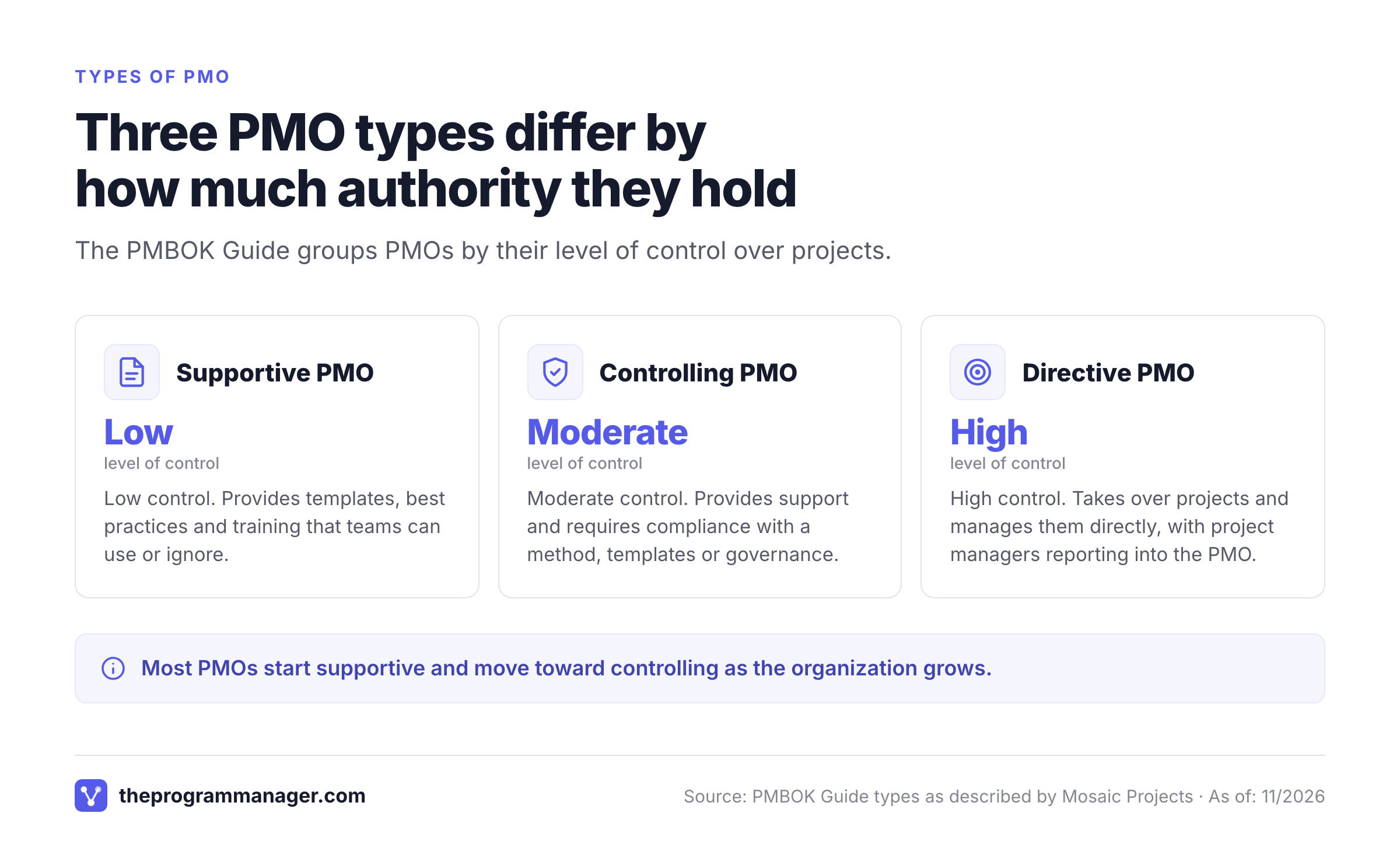
However, most PMOs start supportive and move toward controlling as the organization grows. Still, a directive PMO is the least common, because it concentrates project managers in one team instead of leaving them in the business units.
PMOs by scope
Still, the same office can also be described by where it sits and how far its remit goes.
- Project PMO: set up for one large project or program and closed when it ends.
- Departmental or business-unit PMO: serves one function such as IT, operations or a region, with standards that suit that unit.
- Enterprise PMO (EPMO): covers the whole organization and ties project work to company strategy. It has the broadest remit and the most stakeholders.
- Center of excellence: owns methods, training and tooling rather than reporting on delivery.
- Hub and spoke: a central PMO sets standards while small PMOs inside business units apply them.
These labels overlap, and organizations use them loosely. A much better test than the label is a plain question: who decides, and who has to follow?
PMO vs Project Manager vs Program Manager
A project manager is accountable for one project's scope, schedule, budget and team. A program manager coordinates a group of related projects toward a shared outcome. A PMO serves both by providing method, visibility and governance, and in some organizations it also employs them.
| Role | Focus | Typical output |
|---|---|---|
| Project manager | One project | Delivered project, status updates, risk log |
| Program manager | A set of related projects | Integrated plan, benefits and dependency management |
| PMO | All projects, programs or the portfolio | Standards, reporting, prioritization, tooling |
If you want the detail on the first two, read Program Manager vs Project Manager and Program Management: What It Is and How It Works.
Who Works in a PMO?
Titles vary a lot, but a PMO team usually includes some mix of the following.
- PMO director or head of PMO: owns the mandate, reports to a senior executive and represents the PMO in budget and portfolio decisions.
- PMO manager: runs the office day to day, including processes, reporting calendar and staff.
- Project and program managers: deliver the work, either inside the PMO or on loan to it.
- PMO analyst: collects status data, builds dashboards and chases updates.
- Business or financial analyst: supports business cases, budgets and benefits tracking.
- Risk and compliance specialist: keeps governance and audit requirements covered.
ProjectManager, a software vendor, gives rough sizes: one to five people for a small PMO, five to fifteen for a medium one and more than fifteen for a large one. That's a vendor estimate rather than research, but it matches what most organizations see. Many PMOs start as two people: a lead and an analyst.
When Does an Organization Need a PMO?
You usually need a PMO when the cost of coordination starts to exceed the cost of the people doing the coordinating. Common triggers:
- Several projects compete for the same people, and nobody can say who is overbooked.
- Each team reports status differently, so leadership can't compare projects.
- Projects keep starting without a clear owner, budget or goal.
- The same mistakes repeat because lessons aren't captured anywhere.
- Project priorities drift away from company priorities, and nobody notices until a deadline slips.
A company running two or three projects with a single manager almost certainly doesn't need a PMO. A shared template and a monthly review will do the job. A PMO becomes worth its cost when the number of concurrent projects grows beyond what one leader can track personally.
Benefits and Challenges of a PMO
Benefits. The benefits are consistency, visibility and better decisions. Projects use the same terms and templates, so status is comparable. Leadership sees one picture instead of ten. Resources are moved on purpose rather than by whoever shouts loudest. New project managers get started faster because the method already exists.
Challenges. A PMO can also become overhead. Heavy templates slow small projects down. But a team that treats reporting as a tax will report late and vaguely. Some PMOs are seen as policing rather than helping, which cuts their access to honest information. A PMO without executive backing can't enforce anything, and one that only reports and never decides ends up as a very detailed spreadsheet. The fix is to keep the standards proportional to project size and to show teams what they get back for the effort.
How to Set Up a PMO
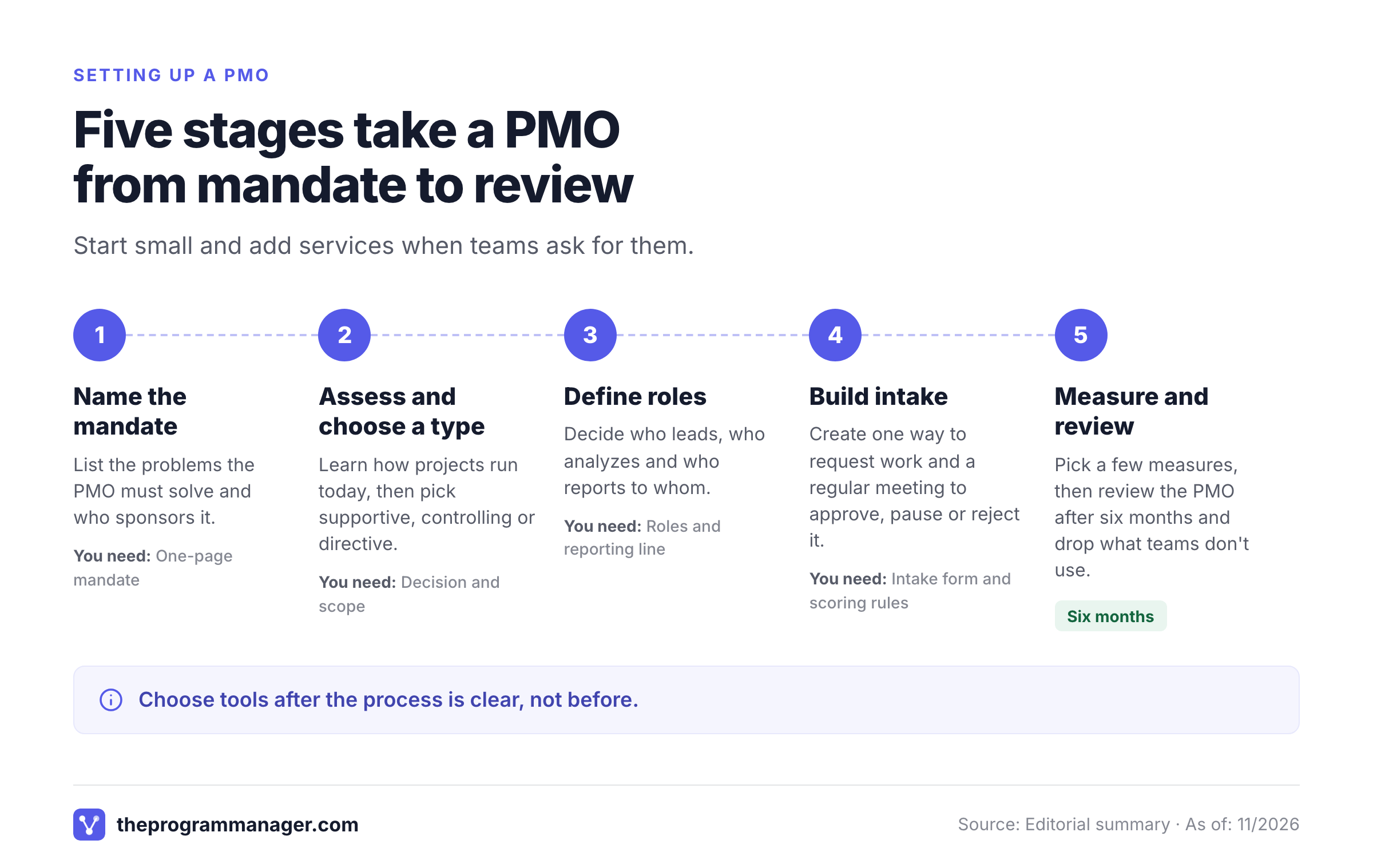
Start small and add services when teams ask for them. This sequence works for most organizations.
Name the problems and the mandate
List the two or three problems the PMO must solve and who sponsors it. Without a sponsor, standards stay optional, which is the single biggest reason new PMOs stall.
Assess current maturity
Find out how projects run today: which methods, which tools, where status lives. Talk to project managers, not only to their bosses.
Choose the type
Pick supportive, controlling or directive based on the maturity you found and how much authority the sponsor will actually give.
Define roles and staff it
Decide who leads, who analyzes and who reports to whom. Document who decides and who must follow, using a RACI chart if it helps.
Build intake and prioritization
Create one way to request work and a regular meeting to approve, pause or reject it.
Pick metrics and a reporting rhythm
Choose a small set of measures, define each one, and agree how often they are reviewed. Reuse the project status report template so every project reports the same way.
Select tooling and review
Choose tools after the process is clear, not before. Review the PMO after six months and drop anything teams don't use.
How to Measure PMO Success
A PMO is judged on whether projects and decisions improve, not on how many reports it produces. Useful measures fall into four groups.
- Delivery: share of projects delivered on time and within budget, using one definition of "on time" everywhere.
- Portfolio: resource utilization, number of active projects against capacity, and how many projects were stopped on purpose.
- Alignment: share of active projects linked to a stated company goal.
- PMO service: time to get a request approved, how current the status data is, and stakeholder feedback from project managers.
Pick no more than a handful of these at the start. A PMO that tracks twenty measures usually has none that anyone acts on.
PMO Tools and Software
PMO work runs on a mix of tools: a work management tool for tasks, a portfolio or program view for reporting, spreadsheets for intake and a place for documents. The useful question is what the PMO needs to see, not which brand to buy. Typical needs are one view across projects, resource and capacity data, roadmaps, dependency and risk tracking, permissions, and reports that don't need manual rework each week.
If you are comparing options, start with Best Program Management Software and Best Enterprise Project Management Software for PMOs. For templates that a new PMO can copy on day one, see Program Management Templates.
FAQ
What does PMO stand for?
PMO most often stands for project management office. It can also mean program management office or portfolio management office, depending on whether the team looks after single projects, groups of related projects or the whole portfolio.
What is the main purpose of a PMO?
The purpose of a PMO is to make projects more consistent and visible. It sets standards, supports project managers, tracks status, coordinates resources and helps leadership decide which projects to fund.
What are the three types of PMO?
PMBOK describes supportive, controlling and directive PMOs. A supportive PMO offers templates and advice, a controlling PMO requires teams to follow a method or governance, and a directive PMO manages projects directly.
Is a PMO manager higher than a project manager?
Usually yes in reporting terms, though it depends on the company. A PMO manager runs the office and its standards across many projects, while a project manager delivers one project. In some firms the two sit at the same grade.
Does a small company need a PMO?
Most do not. If you run a few projects with clear owners, shared templates and a monthly review are enough. A PMO starts to pay off when many projects share people and leadership loses sight of priorities.
What is the difference between a PMO and a project manager?
A project manager is responsible for delivering one project. The PMO provides the method, tools, reporting and governance that all project managers use, and may employ some of them.
Leave a Reply